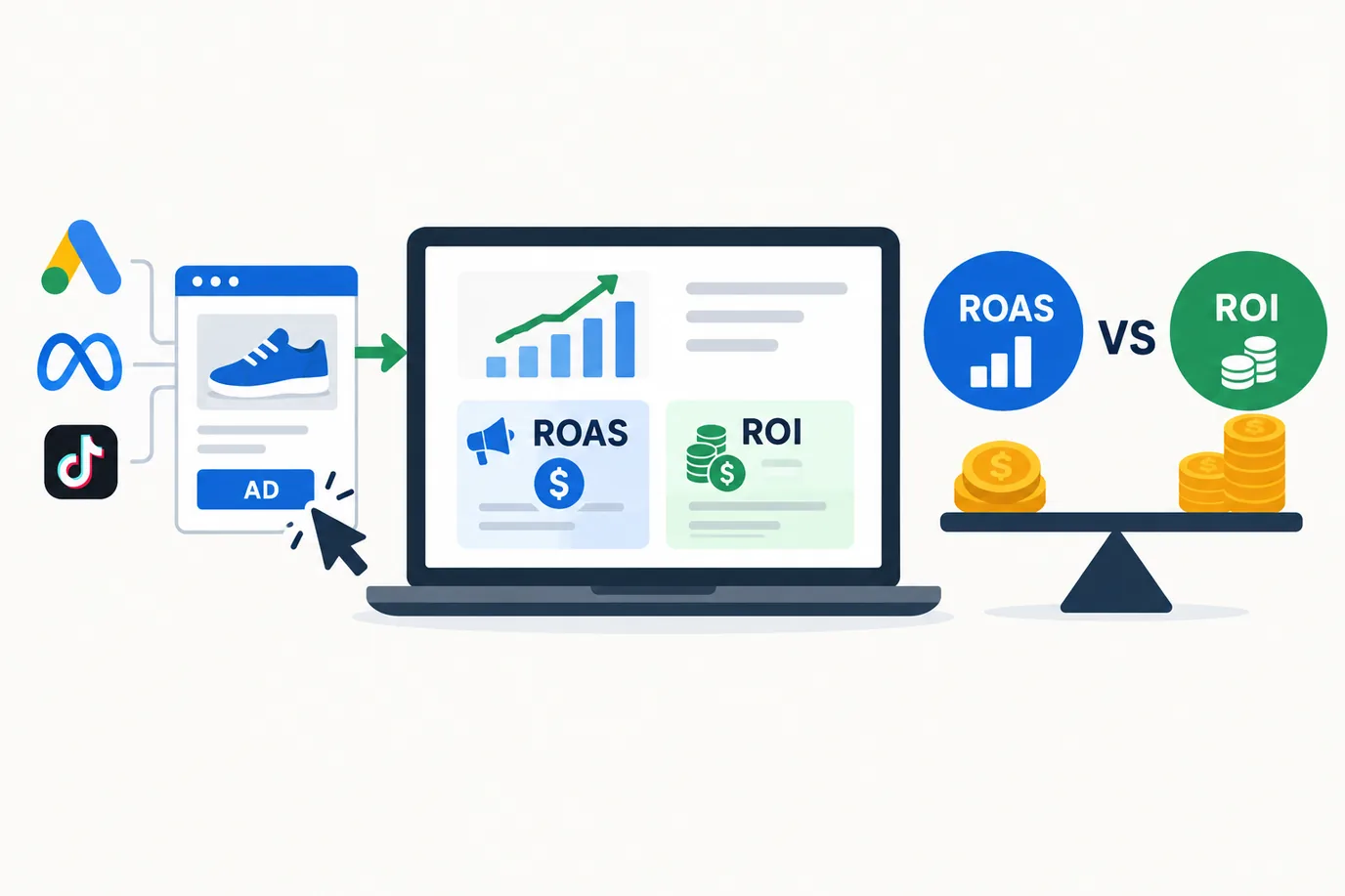
ROAS and ROI Answer Different Questions
- ROAS (return on ad spend) asks: how much revenue did each ad dollar bring? It is revenue divided by ad spend, so $20,000 ÷ $5,000 = 4.0x (also written 4:1 or 400%).
- ROI (return on investment) asks: how much profit did each dollar I spent bring? It is profit divided by cost, and profit takes your product costs into account.
ROAS is the number ad platforms show you because they can see revenue but not your costs. That is exactly why it can be misleading: a high ROAS is not the same as a profit.
👉 Check whether your ads are profitable with our free ROAS calculator →
The Same ROAS, Four Different Outcomes
Take the same campaign: $5,000 in ad spend and $20,000 in revenue, a 4.0x ROAS. What you earn depends on your gross margin, the share of each sale left after the product, shipping and fees, before ads:
| Gross Margin | Gross Profit | Profit After Ads | ROI on Ad Spend | Break-Even ROAS |
|---|---|---|---|---|
| 20% | $4,000 | −$1,000 | −20% | 5.00x |
| 30% | $6,000 | $1,000 | 20% | 3.33x |
| 40% | $8,000 | $3,000 | 60% | 2.50x |
| 50% | $10,000 | $5,000 | 100% | 2.00x |
| 60% | $12,000 | $7,000 | 140% | 1.67x |
Swipe sideways to see all columns. With a 20% margin, a 4.0x ROAS loses $1,000, because you needed 5.0x just to break even. With a 60% margin, a campaign needs only 1.67x to cover itself. The formula is simple: break-even ROAS = 1 ÷ gross margin.
A Complete Example: 40% Margin, 400 Orders
The campaign spent $5,000 and generated $20,000 from 400 orders, and the gross margin is 40%:
| Measure | Result |
|---|---|
| ROAS | 4.00x |
| Break-even ROAS | 2.50x |
| Gross profit before ads ($20,000 × 40%) | $8,000 |
| Profit after ad spend | $3,000 |
| Net margin after ads ($3,000 ÷ $20,000) | 15% |
| ROI on ad spend ($3,000 ÷ $5,000) | 60% |
| Average order value | $50 |
| Cost per order (CPA) | $12.50 |
| Most you can pay per order and break even ($50 × 40%) | $20.00 |
| Profit per order | $7.50 |
Two numbers are worth remembering. The maximum cost per order ($20) tells you how high the advertising cost for a customer can go before you lose money, and the ROAS needed for a target net margin is 1 ÷ (gross margin − target margin): for a 15% net margin at a 40% gross margin, 1 ÷ 0.25 = 4.0x, which is exactly where this campaign sits.
ROAS and ACOS
On some marketplaces, advertising is reported as ACOS (advertising cost of sales): ad spend divided by revenue. It is the inverse of ROAS: a 4.0x ROAS is a 25% ACOS. The break-even ACOS is simply your gross margin: with a 40% margin, you break even at a 40% ACOS. Lower ACOS is better, whereas higher ROAS is better.
What a Discount Does to Your Target
Discounts and shipping promotions reduce your margin and raise your break-even ROAS. Our guide on profit margin vs. markup shows how a 10% discount can halve the profit on a product with a 20% margin. If you run a sale, recalculate the break-even ROAS before you judge the ads.
Why the ROAS Your Platform Reports May Be Too Optimistic
- Attribution. Platforms count sales by their own rules, so the same sale can be claimed by more than one channel.
- Returns and refunds. Reported revenue often includes orders that are later returned.
- Revenue is not margin. The platform does not know your product cost, fees or shipping.
- Repeat customers. Some "ad" sales would have happened anyway, and some first purchases lead to profitable repeat sales that the first campaign does not show.
Compare the platform's figures with your own sales and costs, and use your real gross margin in the calculation.
How to Judge a Campaign: Five Steps
- Find your true gross margin per order, after product, shipping, fees and returns.
- Calculate the break-even ROAS (1 ÷ margin).
- Compare the campaign's ROAS. Above break-even is profitable; the further above, the better.
- Check the profit and the ROI, not just the ROAS.
- Consider lifetime value. If customers buy again, you may accept a lower first-order ROAS, but only if the repeat sales are proven.
If the numbers do not work, you can raise the price, lower the costs, improve the ads or stop the campaign. For the profit on every unit, see our guide to break-even analysis, and for investment-style returns, read ROI explained.
Frequently Asked Questions
What is a good ROAS?
It depends on your margin. A 4:1 ROAS is often quoted as a benchmark, but a business with a 20% margin needs 5:1 to break even, while one with 60% needs about 1.7:1. A good ROAS is one comfortably above your own break-even.
What is the difference between ROAS and ROI?
ROAS compares revenue with ad spend and ignores other costs. ROI compares profit with cost. A campaign can have a high ROAS and a negative ROI.
How do I calculate break-even ROAS?
Divide 1 by your gross margin as a decimal. A 40% margin gives 1 ÷ 0.40 = 2.5.
What is ACOS?
Advertising cost of sales: ad spend divided by revenue. It is the inverse of ROAS, so a 4.0x ROAS is a 25% ACOS.
Should I stop ads that are below break-even?
Not always: new customers may buy again, and some campaigns build awareness. But if the campaign has no clear path to profit, stop or change it, and make sure you can pay for the losses.
Conclusion & Recommended Next Steps
ROAS is a useful signal and a poor verdict. Turn it into a decision by comparing it with your break-even ROAS, and check the profit and ROI before you spend more. Put your own spend, revenue and gross margin in the calculator, and test what happens if the margin falls or the cost per order rises.
ROAS Calculator
Find your ROAS, break-even ROAS and profit after ads.
ROI Calculator
Measure the return on any spend.
Profit Margin Calculator
Find the margin your ads must beat.
Break-Even Calculator
See how many sales cover your fixed costs.
Disclaimer: This guide is intended solely for educational and informational purposes and does not constitute personalized financial, legal, or tax advice. Advertising results vary widely, and the figures above are illustrations based on stated assumptions with made-up round numbers. Use your own costs and sales data, and consult a qualified professional about your business.