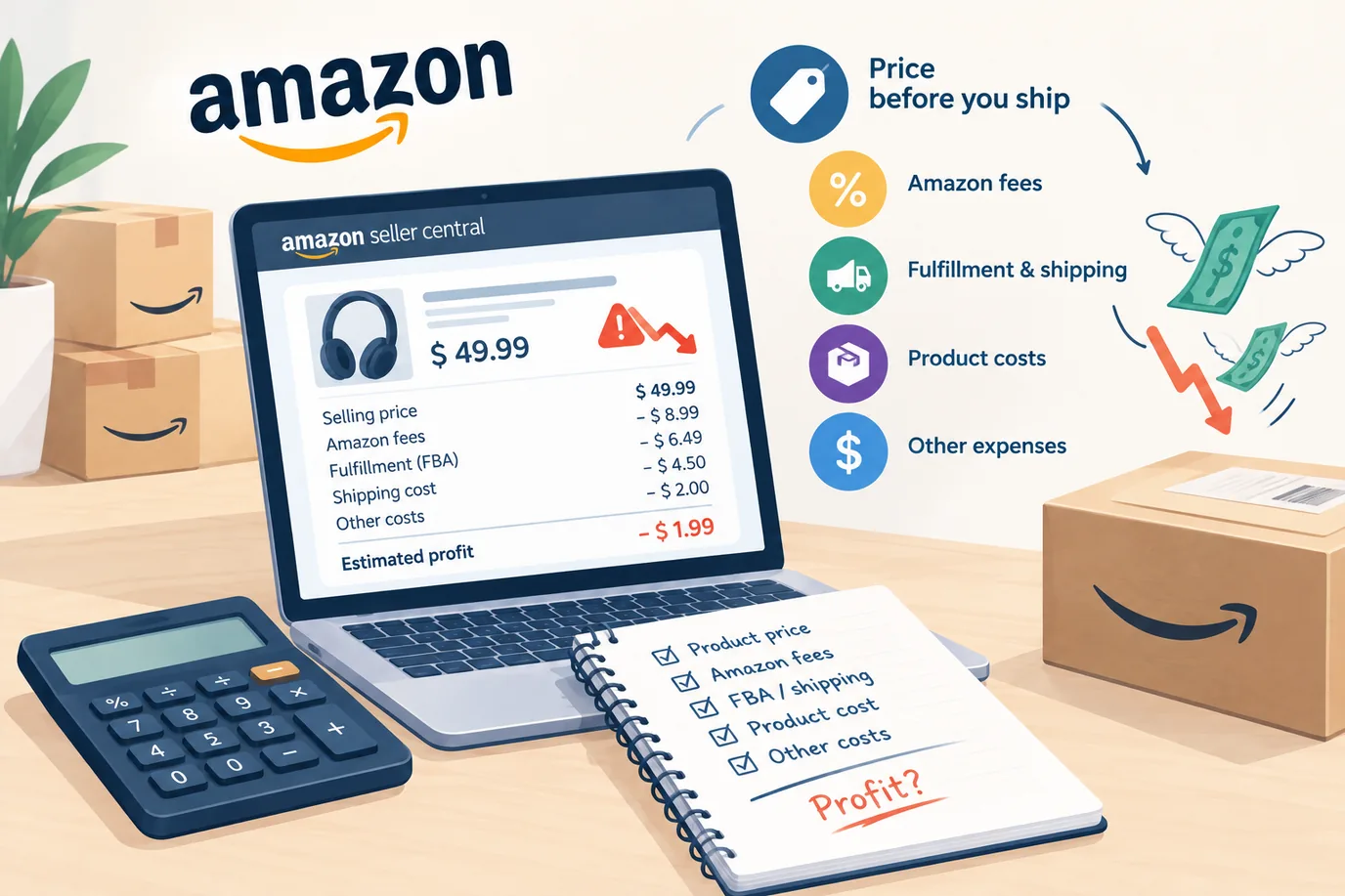
Why the Gap Between Price and Profit Is So Big
A marketplace gives you customers, but it takes a share of each sale, and the product has more costs than the factory price. Beginners often compare the selling price with the cost of the product and think the difference is profit. It is not: it is the money available to pay for everything else.
Marketplace fees change, vary by category and size, and are set by the platform, so check the current fee schedule for your product before you use any number. The figures below are made-up, round examples chosen to show how the math works. Replace them with your own.
👉 Calculate your own selling price and margin with our free Amazon selling price calculator →
The Cost Stack: Everything Between the Price and Your Profit
Imagine this product (example numbers):
| Cost Item | Example Amount | Depends on the Price? |
|---|---|---|
| Product cost (manufacturing and landing) | $12.00 | No |
| Shipping to the warehouse | $1.50 | No |
| Fulfillment and storage per unit | $5.30 | No |
| Marketplace referral fee | 15% of the price | Yes |
| Returns and damaged goods | 4% of the price | Yes |
| Advertising | 10% of the price | Yes |
Swipe sideways to see all columns. The first three add up to a fixed $18.80 per unit. The last three take 29% of the price, so only 71 cents of each dollar are left to cover the $18.80 and your profit.
Profit per unit = 71% × price − $18.80
What Different Prices Do
| Price | Referral Fee | Returns | Ads | Profit per Unit | Margin |
|---|---|---|---|---|---|
| $24.99 | $3.75 | $1.00 | $2.50 | −$1.06 | −4.2% |
| $29.99 | $4.50 | $1.20 | $3.00 | $2.49 | 8.3% |
| $34.99 | $5.25 | $1.40 | $3.50 | $6.04 | 17.3% |
| $39.99 | $6.00 | $1.60 | $4.00 | $9.59 | 24.0% |
At $24.99 you pay the marketplace to sell your product. The break-even price is $26.48, so anything below it loses money, and every dollar you add above it keeps 71 cents. To reach a 20% margin you need $36.87, and for 30%, $45.86. That is far above the "double the cost" rule of thumb, which would have suggested about $24.
The Silent Profit Killers
Advertising
If you spend 10% of the price on ads, a $29.99 price keeps only $2.49 per unit. Without ads, the same sale would leave $5.49 (an 18.3% margin). Ads are often needed to rank a new product, but they are a real cost. Our guide on ROAS vs. ROI shows how to tell whether they pay for themselves.
Returns and damaged units
A returned item may not be resellable, and you may pay shipping twice. Budgeting a percentage for returns is realistic for most categories, and higher for clothing or fragile items.
Fees on the whole amount
Most percentage fees are charged on the total the buyer pays, which can include shipping. Check how your fees are calculated.
Storage and aged inventory
Inventory that sits for months costs money in storage and ties up cash. A slow-selling product can look profitable per unit and still lose money overall.
Buying too much too early
Ordering a large first batch for a product you have not tested multiplies every pricing mistake. Start with a small order and measure real numbers.
A Checklist Before You Order Inventory
- List every cost per unit: product, shipping in, fulfillment, storage, packaging, labels and prep.
- Check the current platform fees for your category and size, and write them as a percentage and a fixed amount.
- Estimate returns and advertising as a share of the price. Use a conservative figure.
- Calculate the break-even price: (fixed costs per unit) ÷ (1 − percentage costs). In the example, $18.80 ÷ 0.71 = $26.48.
- Choose a target margin and calculate the price for it: $18.80 ÷ (0.71 − target margin).
- Compare with competitors. If the price you need is above what buyers pay, the product or its cost needs to change.
- Check your taxes. A seller who is self-employed owes self-employment tax on profit; see our guide on what to set aside.
For the logic behind pricing from a target margin, read profit margin vs. markup.
How Many Units Do You Need to Sell?
If you have fixed monthly costs, such as software, a prep service or a salary, the contribution per unit matters. At $34.99, the profit per unit is $6.04, so $1,000 of monthly fixed costs means about 166 units a month just to cover them. At $29.99 with $2.49 per unit, the same costs require 402 units. Use our break-even guide to calculate it for your business.
Frequently Asked Questions
How do I know if a product is profitable on Amazon?
Add up every cost per unit, including fees, shipping, returns and advertising, and subtract it from the price. If the result is positive at a price buyers will pay, and the margin is high enough for the risk, the product may be worth selling.
What margin should I aim for?
Many sellers look for at least 15% to 30% after all costs, but your target depends on your volume, your risk and the cost of capital tied up in inventory.
Why does my profit differ from the calculator?
Usually because fees, shipping or ad costs differ from the assumptions. Use your own actual numbers from seller reports.
Should I run ads on a new product?
Often yes, to gain visibility, but set a limit and track the cost per sale. If ads take the whole profit with no growth in organic sales, reconsider the price or the product.
Can I lower my costs?
Yes: negotiate with the manufacturer, reduce the size or weight, improve the packaging, cut returns by improving the listing, or sell a higher-priced variation.
Conclusion & Recommended Next Steps
The only reliable way to know whether you can profit is to calculate the profit per unit before you buy inventory, with every cost that moves with the price included. Try a few prices, find your break-even and target prices, and decide from there. Enter your own numbers in the calculator.
Amazon Selling Price Calculator
Find the price that covers every cost and your target margin.
Profit Margin Calculator
Check margin and markup for any price.
ROAS Calculator
See whether your advertising pays for itself.
Break-Even Calculator
Find the units you need to cover your fixed costs.
Disclaimer: This guide is intended solely for educational and informational purposes and does not constitute personalized financial, legal, or tax advice. Marketplace fees, shipping costs and policies change often, and the percentages and dollar amounts in the examples are made-up round numbers for illustration, not actual fee rates. Check the current fee schedule of any marketplace and use your own costs before you set a price.