What Break-Even Means
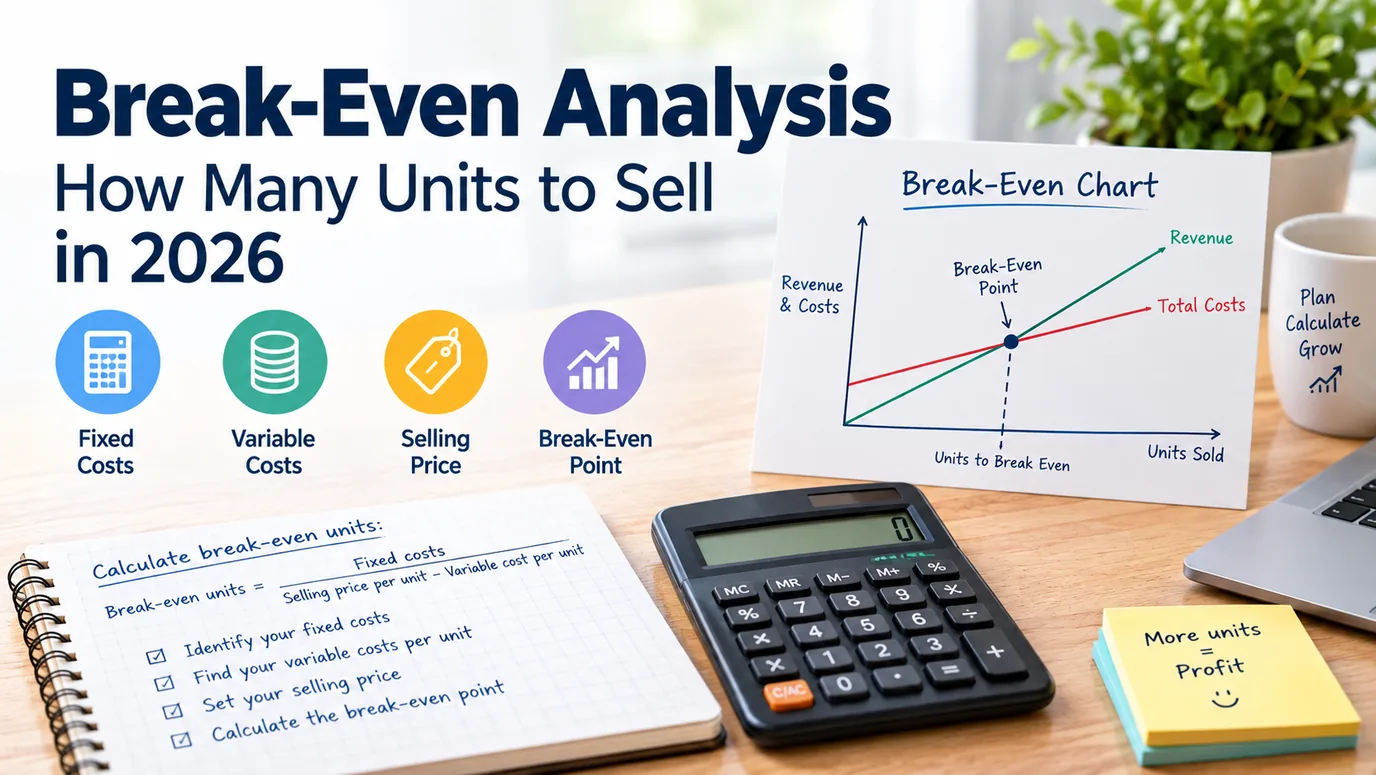
Your break-even point is the level of sales where your revenue equals your total costs: you make no profit and no loss. Below it you lose money, above it every extra sale adds profit. It is one of the simplest and most useful numbers in a business, because it tells you the minimum you must sell before you spend money on inventory, rent or advertising.
Every cost falls into one of two groups:
- Fixed costs do not change with how much you sell: rent, salaries, software subscriptions, insurance, loan payments.
- Variable costs rise with each unit sold: materials, packaging, shipping, payment processing and sales commissions.
The amount each sale contributes toward the fixed costs is the contribution margin: price minus variable cost. In the example, $50 − $20 = $30 per unit, or 60% of the price.
👉 Calculate your own break-even point with our free break-even calculator →
The Formulas
- Break-even units = fixed costs ÷ contribution margin per unit
- Break-even revenue = break-even units × price (or fixed costs ÷ contribution margin ratio)
- Units for a profit goal = (fixed costs + profit goal) ÷ contribution margin per unit
- Margin of safety = (expected units − break-even units) ÷ expected units, how far sales can fall before you start losing money
With $5,000 of fixed costs: $5,000 ÷ $30 = 166.7, so you need 167 units, which is $8,333 in sales. If you expect to sell 300 units a month, your profit is 300 × $30 − $5,000 = $4,000, and your margin of safety is 44%: sales could fall by almost half before you lose money.
What Moves the Break-Even Point
All of these use the example above and change one thing at a time.
Price
| Price per Unit | Contribution per Unit | Break-Even Units | Break-Even Revenue | Profit at 300 Units |
|---|---|---|---|---|
| $45 | $25 | 200 | $9,000 | $2,500 |
| $50 | $30 | 167 | $8,333 | $4,000 |
| $60 | $40 | 125 | $7,500 | $7,000 |
Swipe sideways to see all columns. A $10 price increase cuts the break-even from 167 to 125 units, but remember that a higher price may also reduce how many units you sell.
Variable cost per unit
| Variable Cost per Unit | Contribution per Unit | Break-Even Units | Profit at 300 Units |
|---|---|---|---|
| $15 | $35 | 143 | $5,500 |
| $20 | $30 | 167 | $4,000 |
| $25 | $25 | 200 | $2,500 |
A $5 increase in the cost of each unit, from a supplier, a shipping rate or a fee, raises the break-even by 33 units and cuts profit at 300 units by $1,500.
Fixed costs
| Fixed Costs per Month | Break-Even Units | Break-Even Revenue | Profit at 300 Units | Margin of Safety |
|---|---|---|---|---|
| $3,000 | 100 | $5,000 | $6,000 | 66.7% |
| $5,000 | 167 | $8,333 | $4,000 | 44.4% |
| $8,000 | 267 | $13,333 | $1,000 | 11.1% |
Moving from $5,000 to $8,000 of fixed costs leaves just an 11% margin of safety: a small dip in sales would put you in the red. Adding fixed costs, such as a new hire or a bigger space, raises the bar every month.
Setting a Profit Goal
Break-even is the floor. To earn a target profit, add it to the fixed costs:
| Monthly Profit Goal | Units Needed | Revenue Needed |
|---|---|---|
| $0 (break-even) | 167 | $8,333 |
| $2,500 | 250 | $12,500 |
| $5,000 | 334 | $16,700 |
Compare these with what you can realistically sell. If a $5,000 profit goal needs 334 units but your market or capacity supports only 200, you need a different price, lower costs or a different goal.
When Sales Fall Short
If you expect fewer sales than the break-even number, you lose money every month:
| Units Sold per Month | Result |
|---|---|
| 120 | Loss of $1,400 |
| 150 | Loss of $500 |
| 167 | Break-even |
| 300 | Profit of $4,000 |
The Danger of a Thin Contribution Margin
The contribution margin per unit is the engine of the whole analysis. If it is small, the break-even climbs fast. Suppose the price is $35 and the variable cost is $30, leaving only $5 per unit:
- You need $5,000 ÷ $5 = 1,000 units a month to break even, six times more than before.
- Selling 300 units would mean a loss of $3,500 a month.
A product can look profitable per sale and still never cover the business's fixed costs. Before you launch or lower a price, calculate the contribution margin and the units you must sell. Our guide on profit margin vs. markup shows how to price from a target margin.
Limits of Break-Even Analysis
- It assumes costs stay constant. Real fixed costs jump when you need more space or staff, and variable costs can change with volume discounts.
- It assumes the same price for every unit. Discounts, bundles and different products change the average.
- It ignores timing. You may need to pay for inventory and advertising before the sales arrive.
- It does not include your own pay unless you add it to fixed costs. A business that breaks even but pays you nothing is not sustainable.
- It does not include taxes. A sole proprietor owes self-employment tax on profit; see our guide on what to set aside.
Include your own salary in fixed costs if you want the business to pay you. If you do the work as a freelancer, our guide on setting your hourly rate covers that case.
How to Lower Your Break-Even Point
- Raise the price if the market allows it, or sell a premium version.
- Cut variable costs with better suppliers, cheaper shipping or fewer returns.
- Cut or delay fixed costs, such as unused subscriptions or space.
- Increase the contribution margin of the mix, by selling more of your higher-margin products.
- Reduce losses from discounts, which erode contribution margin quickly.
Frequently Asked Questions
How do you calculate break-even units?
Divide the fixed costs by the contribution margin per unit, which is the price minus the variable cost per unit. Round up to the next whole unit.
What is the contribution margin?
The amount each unit sold contributes toward covering fixed costs and then profit: the price minus the variable cost per unit. It can also be shown as a percentage of the price.
What is a good margin of safety?
There is no single number. A higher margin of safety means sales can fall further before you lose money; many owners aim for a cushion of at least 20% to 30%, and more when sales are uncertain.
Does break-even include my salary?
Only if you list it as a fixed cost. If you want the business to pay you, add that amount to fixed costs, or use the profit-goal field.
Can I use break-even analysis for a single product?
Yes. Use the product's price and variable cost, and the share of fixed costs you expect it to cover. For several products, use an average price and cost weighted by sales.
Conclusion & Recommended Next Steps
Knowing your break-even point tells you how much you need to sell before you make money, and how much room you have if sales dip. Calculate it before you set a price, take on a new cost or launch a product. Put your fixed costs, price and variable cost in the calculator, then test a lower price, a higher cost and a profit goal.
Break-Even Calculator
Find the units and revenue you need to cover your costs.
Profit Margin Calculator
Price a product from the margin you want.
ROI Calculator
Measure the return on a business investment.
Freelance Rate Calculator
Set an hourly rate that covers costs and taxes.
Disclaimer: This guide is intended solely for educational and informational purposes and does not constitute personalized financial, legal, or tax advice. The figures above are illustrations based on the stated assumptions and use made-up round numbers; use your own actual costs and prices. Consult a qualified professional about your business.