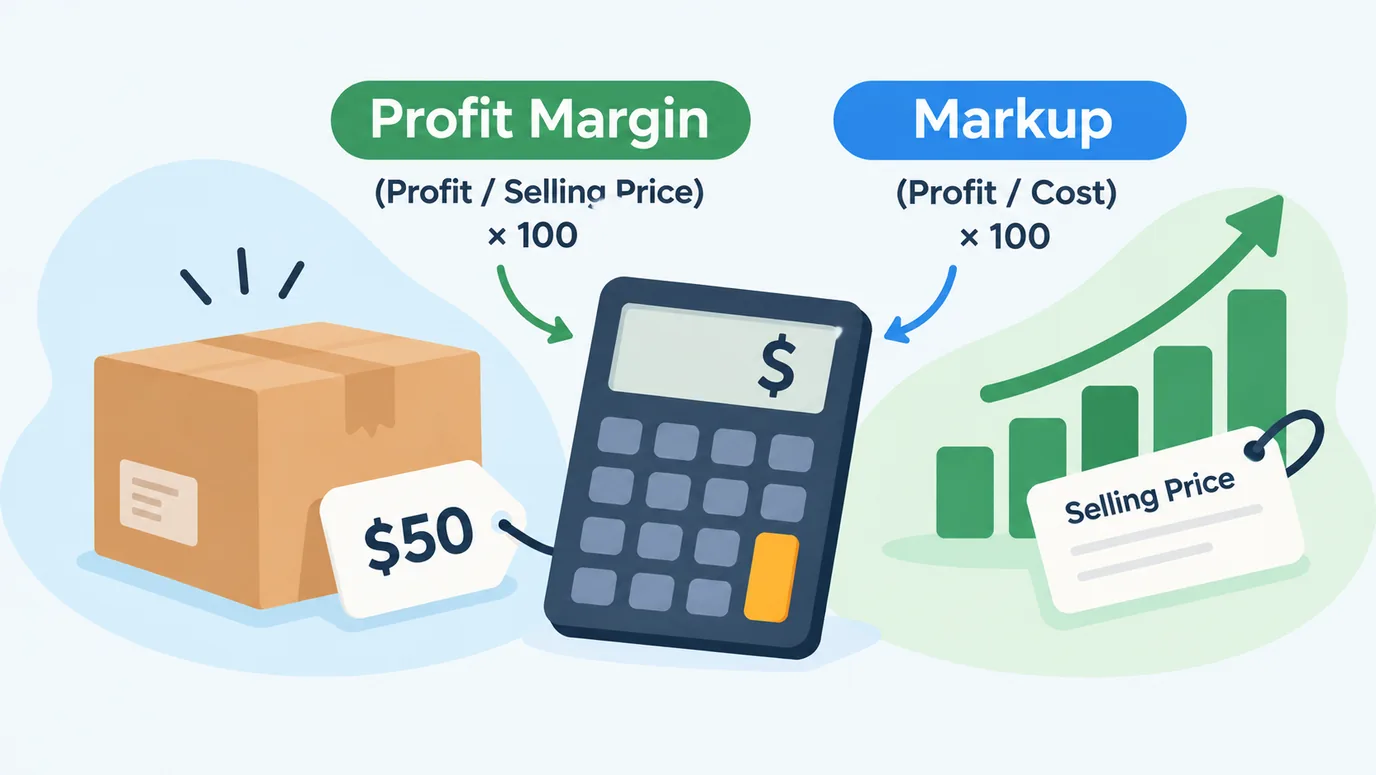
Two Words, Two Different Percentages
People often use "margin" and "markup" as if they meant the same thing. They do not, and mixing them up is one of the most common pricing mistakes.
- Markup = (price − cost) ÷ cost. How much you add on top of what you paid.
- Margin = (price − cost) ÷ price. How much of every sales dollar is profit.
Because the price is larger than the cost, margin is always a smaller number than markup. A 50% markup is a 33% margin; a 100% markup is only a 50% margin.
👉 Check your own price, margin and markup with our free profit margin calculator →
Margin and Markup Side by Side
For a product that costs $40 to buy or make:
| Markup You Apply | Selling Price | Profit per Unit | Resulting Margin |
|---|---|---|---|
| 25% | $50.00 | $10.00 | 20.0% |
| 50% | $60.00 | $20.00 | 33.3% |
| 75% | $70.00 | $30.00 | 42.9% |
| 100% | $80.00 | $40.00 | 50.0% |
Swipe sideways to see all columns. And the other way around, if you want a target margin:
| Target Margin | Price You Must Charge | Profit per Unit | Markup Needed |
|---|---|---|---|
| 20% | $50.00 | $10.00 | 25.0% |
| 30% | $57.14 | $17.14 | 42.9% |
| 40% | $66.67 | $26.67 | 66.7% |
| 50% | $80.00 | $40.00 | 100.0% |
| 60% | $100.00 | $60.00 | 150.0% |
The formula for a target margin is: price = cost ÷ (1 − target margin). For a 30% margin: $40 ÷ 0.70 = $57.14. A seller who adds 30% to the cost ($52) would have a margin of only 23.1%, which is 7 points short of the goal.
Gross Margin vs. Net Margin
The margin above only subtracts the cost of the product, which is gross margin. A business also pays rent, software, insurance, labor, marketing and taxes. What remains after all of that is the net margin. A simple monthly example:
| Item | Amount | Share of Sales |
|---|---|---|
| Sales | $10,000 | 100% |
| Cost of the products sold | −$6,000 | 60% |
| Gross profit | $4,000 | 40% gross margin |
| Overhead (rent, software, ads, other) | −$2,500 | 25% |
| Net profit | $1,500 | 15% net margin |
A 40% gross margin looked healthy, but only 15 cents of each dollar stayed with the owner. When you set prices, make sure the gross margin is large enough to pay for everything else and still leave a profit.
Discounts Hurt More Than They Look
A discount does not reduce your margin by the discount percentage: it takes the entire discount out of your profit. For a product that costs $80 and sells for $100 (a 20% margin):
| Discount | New Price | Profit per Unit | New Margin | Units You Must Sell to Earn the Same Total Profit |
|---|---|---|---|---|
| 0% | $100.00 | $20.00 | 20.0% | 1.0 |
| 5% | $95.00 | $15.00 | 15.8% | 1.33 |
| 10% | $90.00 | $10.00 | 11.1% | 2.0 |
| 15% | $85.00 | $5.00 | 5.9% | 4.0 |
| 20% | $80.00 | $0.00 | 0.0% | never |
A 10% discount cuts the profit in half and means you must sell twice as many units to earn the same money. At 20% off, you are selling at cost and making nothing. Before you run a sale, calculate how many extra sales you need.
The Mistake That Costs the Most: Forgetting Fees and Hidden Costs
Costs that depend on the sale price, such as payment processing, platform commissions and sales-channel fees, are easy to leave out of a price. Because they take a percentage of the price, you cannot just add them to the cost. The formula must include them:
price = (cost + fixed fees) ÷ (1 − fee percentage − target margin)
Here is an illustration with made-up round numbers: a product with a cost of $20 plus $6 to ship it, and fees of 15% of the sale plus $0.50 (replace these with your real figures). To earn a 30% margin you need:
($26 + $0.50) ÷ (1 − 0.15 − 0.30) = $48.18
Now see what happens to a seller who ignores the fee and prices for a 30% margin on cost alone ($26 ÷ 0.70 = $37.14):
| Price Chosen | Fees (15% + $0.50) | Profit | Real Margin |
|---|---|---|---|
| $37.14 (ignoring fees) | $6.07 | $5.07 | 13.7% |
| $48.18 (fees included) | $7.73 | $14.45 | 30.0% |
The seller who forgot the fees thought they would make 30% and made 13.7%, less than half. Add returns, ads, free shipping or a discount, and the profit can disappear completely.
Costs that are often forgotten
- Shipping and packaging, including what you pay if you offer "free shipping"
- Payment processing and marketplace fees, which are usually a percentage of the total
- Returns, refunds and damaged goods
- Advertising and the cost of acquiring each customer
- Your own time, valued at what you could earn elsewhere
- Taxes, including self-employment tax if you are a sole proprietor (see our guide to self-employment tax)
Five Rules for Pricing
- Know the full cost per unit, including everything above.
- Choose your target margin first, then calculate the price from it.
- Use margin, not markup, to compare products, so numbers mean the same thing.
- Check the price against the market. If the price you need is above what customers pay, the product or the cost needs to change.
- Recalculate when costs change. Supplier prices, fees and shipping costs move.
To find out how many units you need to sell to cover your fixed costs, see our guide to break-even analysis.
Frequently Asked Questions
What is the difference between margin and markup?
Markup is profit divided by cost; margin is profit divided by the selling price. A 50% markup equals a 33.3% margin.
How do I calculate the price for a target margin?
Divide the cost by one minus the margin you want. For a $40 cost and a 30% margin, the price is $40 ÷ 0.70 = $57.14.
What is a good profit margin?
It depends on the industry. Retail, services, software and manufacturing have very different norms, so compare with similar businesses and make sure your net margin covers your own pay and the risk you take.
Why is my profit lower than my margin calculation?
Usually because some costs, such as fees, shipping, returns, ads or discounts, were left out. Recalculate with every cost per unit.
How much can I discount?
Only as much as your margin allows. Calculate the new margin and the extra units you need to sell before you run a promotion.
Conclusion & Recommended Next Steps
Price from a target margin, not from a feeling, and include every cost that depends on the sale. Use the calculator to check each product before you list it, and test what a discount or a fee increase would do to your profit.
Profit Margin Calculator
Find the price, margin and markup for any product.
Break-Even Calculator
See how many units cover your fixed costs.
Amazon Selling Price Calculator
Work out the price that covers fees and costs.
ROAS Calculator
Check if your advertising pays for itself.
Disclaimer: This guide is intended solely for educational and informational purposes and does not constitute personalized financial, legal, or tax advice. The fee rates and costs in the examples are made-up round numbers for illustration; use your own actual figures. Consult a qualified professional about your business.