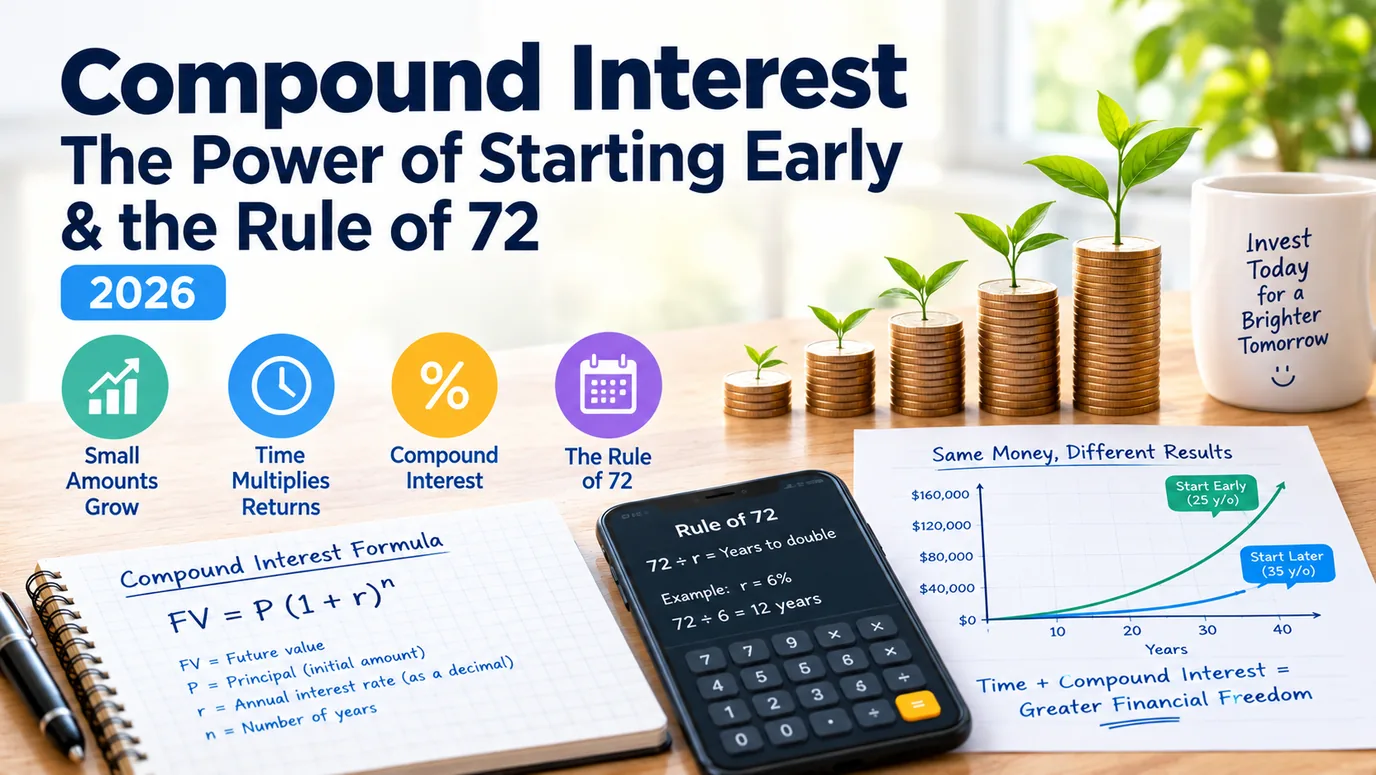
What Compound Interest Really Is
Simple interest pays you only on the amount you originally put in. Compound interest pays you on the original amount plus all the interest it has already earned. Each period the base gets bigger, so the growth accelerates, slowly at first and then faster.
The formula for a lump sum is A = P × (1 + r ÷ n)^(n × t), where P is the starting amount, r the yearly rate, n the number of times per year interest is added and t the years. When you add money regularly, each deposit starts compounding from the day it goes in.
All the examples in this guide use the same simple assumptions: interest compounds monthly, deposits are made at the end of each month, and the 8% return is an assumption for illustration, not a prediction or a guarantee. Real investment returns change from year to year, and taxes and fees are not included.
👉 Project your own savings with our free compound interest calculator →
Time Is the Biggest Lever
Starting with $10,000 and adding $500 a month at 8%:
| Years | Final Balance | You Contributed | Interest Earned | Share That Is Growth |
|---|---|---|---|---|
| 10 | $113,669 | $70,000 | $43,669 | 38% |
| 20 | $343,778 | $130,000 | $213,778 | 62% |
| 30 | $854,537 | $190,000 | $664,537 | 78% |
| 40 | $1,988,238 | $250,000 | $1,738,238 | 87% |
Swipe sideways to see all columns. Doubling the time from 20 to 40 years does not double the result: it multiplies it by almost six. In the first decade only 38% of the balance is growth, and by year 40 it is 87%.
The Cost of Waiting: Start at 25, 35, 45 or 55
Now compare four people who each invest $500 a month at 8% until age 65, starting from zero:
| Start Age | Years Investing | Balance at 65 | You Contributed | Interest Earned |
|---|---|---|---|---|
| 25 | 40 | $1,745,504 | $240,000 | $1,505,504 |
| 35 | 30 | $745,180 | $180,000 | $565,180 |
| 45 | 20 | $294,510 | $120,000 | $174,510 |
| 55 | 10 | $91,473 | $60,000 | $31,473 |
Starting at 25 instead of 35 means contributing only $60,000 more but ending with about $1,000,000 more. Waiting ten years cost this saver more than half of their potential balance.
The 10-Year Head Start Beats 30 Years of Late Saving
The most surprising comparison is between two savers:
- Early Eva invests $500 a month from 25 to 35, stops after 10 years, and leaves the money invested until 65. Total contributed: $60,000.
- Late Leo waits until 35 and invests $500 a month for 30 years until 65. Total contributed: $180,000.
| Saver | Contributed | Balance at 65 |
|---|---|---|
| Early Eva (10 years, then stops) | $60,000 | $1,000,324 |
| Late Leo (30 years) | $180,000 | $745,180 |
Eva contributes one third as much money and ends up with about $255,000 more, because her first decade of deposits had 30 extra years to compound. Eva's example is not advice to stop saving, but it shows why early contributions are worth so much.
How the Rate of Return Changes Things
The same $10,000 start and $500 a month over 20 years at different yearly rates:
| Yearly Return | Balance After 20 Years |
|---|---|
| 4% | $205,613 |
| 6% | $264,122 |
| 8% | $343,778 |
| 10% | $452,965 |
Each 2-point difference in return is worth tens of thousands of dollars. That is why fees matter: a fund that charges 1% a year takes a meaningful bite out of the return. See our ETF and index fund calculator for how expense ratios affect your result.
Does Compounding Frequency Matter?
Interest can be added yearly, quarterly, monthly or daily. For $10,000 at 8% over 10 years, with no deposits:
| Compounding | Balance After 10 Years |
|---|---|
| Annually | $21,589 |
| Quarterly | $22,080 |
| Monthly | $22,196 |
| Daily | $22,253 |
More frequent compounding helps, but only a little: from yearly to daily adds about $664 on $10,000 over a decade. The rate and the time matter far more than the frequency.
The Rule of 72: A Quick Way to Estimate Doubling Time
To estimate how long money takes to double, divide 72 by the yearly return. It is a mental shortcut, close to the exact answer for typical rates:
| Yearly Return | Rule of 72 | Exact Doubling Time (Monthly Compounding) |
|---|---|---|
| 4% | 18 years | 17.4 years |
| 6% | 12 years | 11.6 years |
| 8% | 9 years | 8.7 years |
| 10% | 7.2 years | 7.0 years |
| 12% | 6 years | 5.8 years |
At 8%, $10,000 becomes about $22,196 in 10 years, $49,268 in 20, $109,357 in 30 and $242,734 in 40. It doubles roughly every nine years, and each doubling is bigger than the one before.
Compounding Works Against You on Debt
The same math that builds wealth makes debt expensive. A credit card balance compounds at a high rate, and paying only the minimum can leave you in debt for years. Our guide on how credit card interest works shows how fast it grows.
How to Put Compounding to Work
- Start now, even small. The early dollars do the most work. Waiting for a "better time" has a real cost.
- Automate your deposits so saving happens without a decision each month.
- Capture any employer match in your 401(k): it is an immediate return on your contribution. See our guide on Roth IRA vs. 401(k) for how to order your accounts.
- Keep fees low. Small yearly fees compound against you.
- Reinvest dividends and interest so they keep compounding.
- Stay invested through ups and downs. Selling after a drop locks in a loss and breaks the compounding chain.
Frequently Asked Questions
What is the formula for compound interest?
For a lump sum it is A = P × (1 + r ÷ n)^(n × t). When you add a fixed deposit each period, the future value of those deposits is added to it using the annuity formula, which is what the calculator does.
Is 8% a realistic return?
It is an illustration. Broad stock market returns have averaged around that level or higher over long periods, but they vary a lot from year to year and are never guaranteed. Savings accounts and bonds usually pay less. Try several rates in the calculator to see how sensitive your plan is.
How much should I save each month?
A common starting target is around 10% to 15% of your income for retirement, including any employer match, but your own number depends on your goals and age. The calculator shows what different monthly amounts could become.
Is it too late to start at 45 or 55?
No. Starting later means you need to save more each month to reach the same goal, but compounding still works over 10 or 20 years, and catch-up contributions in retirement accounts allow extra savings after 50.
Does inflation reduce compound growth?
Yes. Prices rise over time, so the buying power of a future balance is lower than the number suggests. Our inflation calculator shows what a future amount is worth in today's dollars.
Conclusion & Recommended Next Steps
Compound interest rewards time, consistency and patience. Starting early matters more than investing a large amount later, and keeping costs low lets more of the return stay in your pocket. Put your own starting amount, monthly deposit, expected return and time horizon in the calculator, then compare what happens if you start five years sooner.
Compound Interest Calculator
See how your savings grow with regular deposits.
ETF & Index Fund Calculator
Add fund fees and inflation to your projection.
Savings Goal Calculator
Find the monthly amount to reach a target.
Inflation Calculator
See what a future balance is worth in today's dollars.
Disclaimer: This guide is intended solely for educational and informational purposes and does not constitute personalized financial, investment, legal, or tax advice. Investment returns are not guaranteed, vary from year to year and are reduced by fees and taxes, and the figures above are illustrations based on the stated assumptions. Consult a qualified financial professional before you invest.