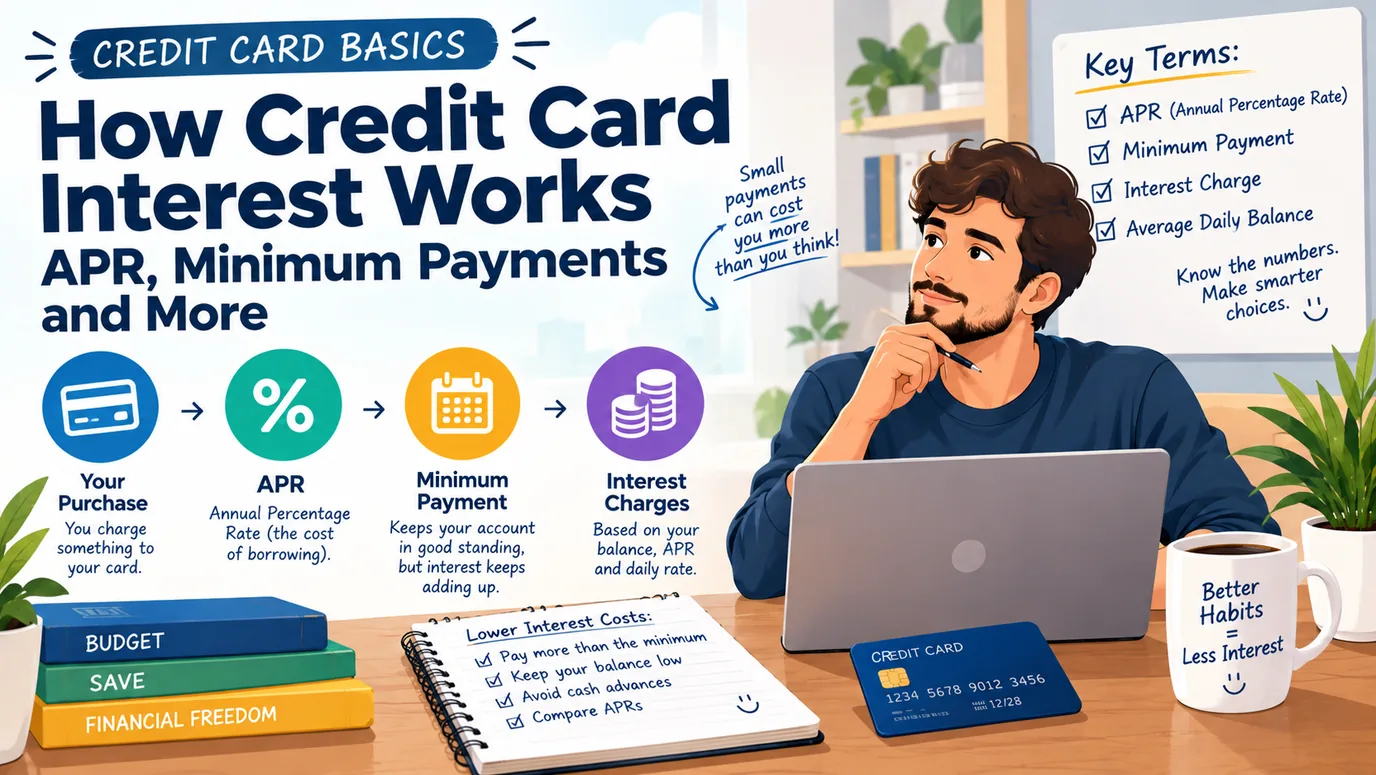
APR Is Not the Whole Story: How the Interest Is Charged
Your APR (annual percentage rate) is the yearly cost of borrowing on the card. But issuers do not charge it once a year. They convert it to a daily periodic rate, apply it to your balance each day, and add that interest to the balance, so the next day's interest is charged on a slightly larger amount. That is compounding.
The simple version of the math is:
Daily interest = balance × (APR ÷ 365)
For a $4,500 balance at 22.99% APR: $4,500 × (0.2299 ÷ 365) = $2.83 a day. Over a 30-day cycle that is about $85, and a calculator that charges one-twelfth of the APR a month shows $86.21. Both are close, and both mean that more than $1,000 of the next year's payments could go to interest alone.
👉 Calculate your own card's interest with our free credit card interest calculator →
Grace Period: When You Pay No Interest at All
If you pay the full statement balance every month by the due date, most cards charge no interest on new purchases. That interest-free window is called the grace period. It disappears the moment you carry a balance: then new purchases start accruing interest from the day you make them. Cash advances usually have no grace period at all and often carry a higher rate plus a fee.
The federal Credit CARD Act requires issuers to mail your statement at least 21 days before the payment due date, so you have a fair chance to pay in full.
The Minimum Payment Trap
Issuers set the minimum with a formula. A common one is the interest plus about 1% of the balance (or 2% to 3% of the balance), with a floor of $25 to $35. Each issuer sets its own rule, and your statement shows yours. For $4,500 at 22.99%, interest plus 1% comes to about $132.
Because most of that payment is interest, very little reduces the balance. If you keep paying that $132:
| Monthly Payment | Time to Pay Off | Total Interest | Total Paid |
|---|---|---|---|
| $132 (about the minimum) | 56 months (4.7 years) | $2,864.90 | $7,364.90 |
| $150 | 46 months (3.8 years) | $2,258.76 | $6,758.76 |
| $174.17 | 36 months (3 years) | $1,770.12 | $6,270.12 |
| $235.66 | 24 months (2 years) | $1,155.84 | $5,655.84 |
| $250 | 23 months | $1,071.58 | $5,571.58 |
| $400 | 13 months | $617.27 | $5,117.27 |
| $423.32 | 12 months (1 year) | $579.84 | $5,079.84 |
Swipe sideways to see all columns. The first row assumes you keep paying the same $132 every month. Real minimums shrink as your balance falls, which makes the payoff even slower, so this is a best case for paying the minimum. Going from the minimum to $250 saves about $1,793 in interest and 33 months of payments.
Your credit card statement is required to show this too: it must state how long it would take to pay off the balance with minimum payments only, the total cost, and the monthly payment needed to pay it off in three years.
How Much Your APR Matters
The same $250 monthly payment on a $4,500 balance, with different APRs:
| APR | First-Month Interest | Payoff Time at $250 | Total Interest at $250 | Total Interest at the Minimum |
|---|---|---|---|---|
| 15% | $56.25 | 21 months | $630.03 | $1,765.13 |
| 22.99% | $86.21 | 23 months | $1,071.58 | $2,864.90 |
| 29.99% | $112.46 | 25 months | $1,552.57 | $3,463.33 |
Moving from a 15% card to a 29.99% card more than doubles the interest on the same payments ($630 vs. $1,553). A lower rate, through a balance transfer or a consolidation loan, can save more than a bigger payment.
When the Balance Is Large, the Trap Gets Worse
Interest is charged on the whole balance, so a bigger balance makes a fixed payment far less effective. At 22.99% APR, paying $250 a month:
| Starting Balance | Payoff Time at $250 | Total Interest |
|---|---|---|
| $4,500 | 23 months | $1,071.58 |
| $10,000 | 77 months (6.4 years) | $9,153.34 |
With $10,000, the interest ($9,153) is almost as much as the debt itself. And below a certain payment the balance never goes down at all: if the payment does not cover the first month's interest, you owe more every month.
Five Ways to Pay Less Interest
- Pay more than the minimum, and pay it early. Because interest is calculated daily, a payment made earlier in the cycle reduces the balance sooner.
- Choose a payoff method. The avalanche method pays the highest rate first, saving the most interest, while the snowball pays the smallest balance first for motivation. Our guide on paying off $10,000 of credit card debt compares them with real numbers.
- Consider a balance transfer card. Some cards offer a 0% introductory rate for a limited time, usually with a transfer fee of about 3% to 5%. It helps only if you can pay the balance off before the promotion ends.
- Consider a consolidation loan. A fixed-rate personal loan at a lower rate than your cards can lower the cost and set a clear end date. Compare it with a personal loan calculator before you decide.
- Stop adding new purchases to the card while you pay it down, since new spending raises the balance you are paying interest on.
Frequently Asked Questions
How is credit card interest calculated?
The issuer divides your APR by 365 to get a daily periodic rate, multiplies it by your balance each day and adds the interest to the balance. The interest for a billing cycle is the sum of those daily amounts.
What is a good APR for a credit card?
Rates vary with your credit profile and the type of card, and many cards charge well over 20%. Lower is always better, and credit unions and some banks offer lower rates for borrowers with strong credit.
Does paying the minimum hurt my credit score?
Paying on time at least the minimum avoids late fees and a late-payment mark, which is important for your score. A high balance compared with your limit (credit utilization) can still lower your score, so reducing the balance helps in two ways.
Why does my statement balance not match what I owe today?
The statement balance is a snapshot at the end of the billing cycle. New purchases, payments and daily interest since then change what you owe today. The amount that avoids interest is the full statement balance by the due date.
Is a balance transfer worth it?
It can be, if the fee is lower than the interest you would pay and you can repay the balance before the promotional rate ends. After that the rate usually jumps, so have a plan to pay it off in time.
Conclusion & Recommended Next Steps
Credit card interest is a daily cost that compounds, and paying the minimum makes it last for years. Check your APR, calculate what your balance costs each month, and then compare what happens if you add even $50 or $100 a month. Use the calculators to set a payoff date and choose the payment that gets you there.
Credit Card Interest Calculator
See your daily and monthly interest charge at your APR.
Credit Card Payoff Calculator
Find the payment that makes you debt-free by your target date.
Personal Loan Calculator
Compare a consolidation loan with your card's cost.
50/30/20 Budget Calculator
Find room in your budget for a bigger debt payment.
Disclaimer: This guide is intended solely for educational and informational purposes and does not constitute personalized financial, investment, legal, or tax advice. Card rates, fees, minimum payment formulas and promotional terms vary by issuer and change over time, and the figures above are illustrations based on the stated assumptions. Check your own card agreement and statement, and consider speaking with a nonprofit credit counselor if you are struggling with debt.