Why $10,000 in Credit Card Debt Is So Expensive
Credit card interest is the most expensive mainstream consumer debt. APRs on most cards sit well above 20%, and interest compounds on your unpaid balance every month.
At a 22% APR, a $10,000 balance generates about $183 in interest in the very first month. If your payment barely exceeds that, almost none of it reduces what you owe. That is the trap: a balance that looks manageable can sit for years while interest eats the progress.
The numbers below use a 22% APR for a single card, and three different card APRs for the multi-card example. Your own rates will differ, so plug your exact numbers into our payoff tool.
👉 Build your personalized payoff plan with our free calculator →
What Different Monthly Payments Really Cost
Here is $10,000 at a 22% APR with no new purchases, paid at a fixed amount each month:
| Monthly Payment | Time to Pay Off | Total Interest | Total Paid |
|---|---|---|---|
| Minimum only* | ≈ 299 months (24.9 yrs) | $17,266 | $27,266 |
| $300 | 52 months (4 yrs 4 mo) | $5,596 | $15,596 |
| $500 | 26 months (2 yrs 2 mo) | $2,571 | $12,571 |
| $750 | 16 months | $1,573 | $11,573 |
| $1,000 | 12 months | $1,149 | $11,149 |
Swipe sideways to see all columns. *Minimum assumed to be the greater of $25 or 1% of the balance plus that month's interest, which is a common issuer formula. It shrinks as your balance falls, which is why it takes so long.
Raising your payment from $300 to $500 saves about $3,025 in interest and cuts 26 months off the timeline. Extra dollars early have an outsized impact.
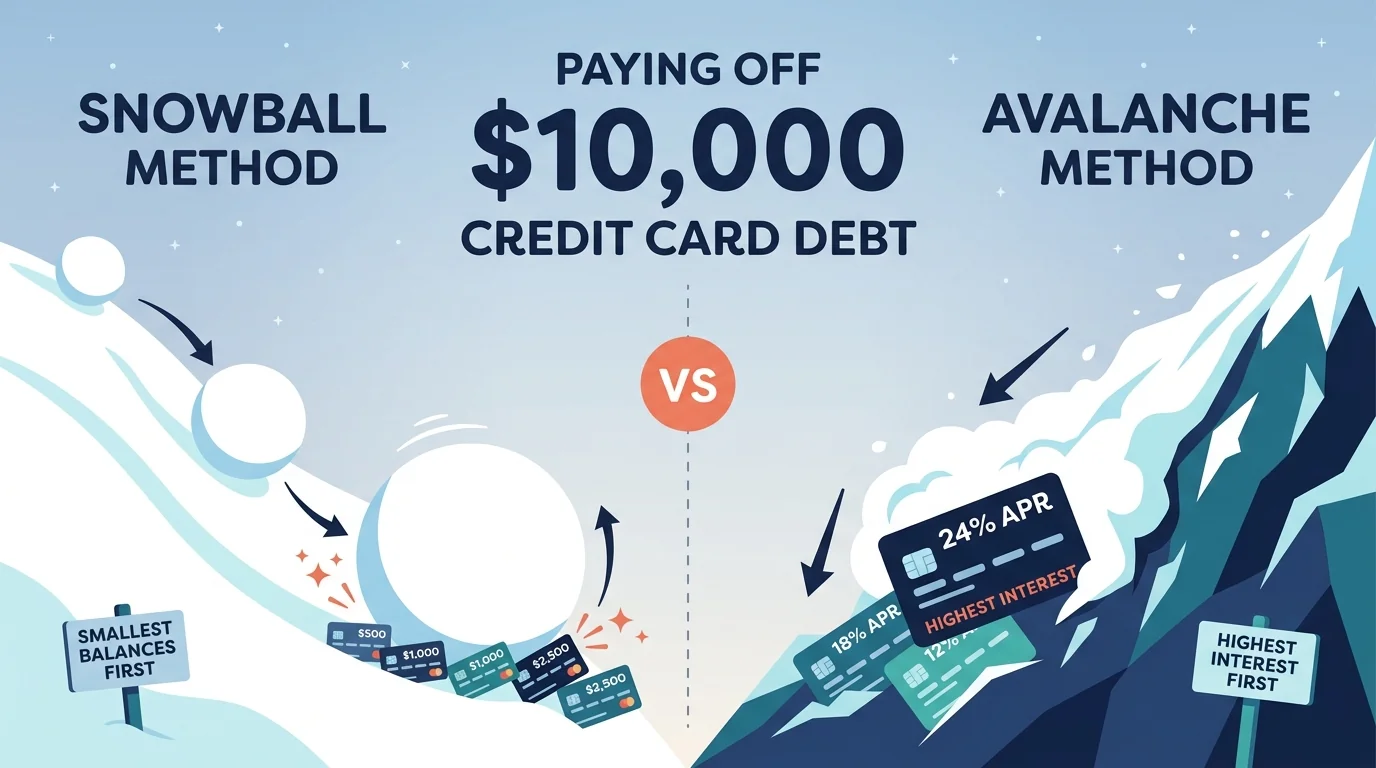
Snowball vs. Avalanche: How Each Method Works
Both strategies share the same core: pay the minimum on every card, then direct all remaining money to one target card. When it is paid off, roll its entire payment into the next target.
- Debt snowball: target the smallest balance first, regardless of APR. You eliminate accounts quickly, which builds momentum.
- Debt avalanche: target the highest APR first. This minimizes total interest and is the mathematically optimal approach.
Real Example: Three Cards, $10,000, $500 a Month
Suppose your $10,000 is split across three cards, and you can put $500 per month toward all of them combined:
| Card | Balance | APR | Starting Minimum |
|---|---|---|---|
| Card A | $1,500 | 17.99% | ≈ $37 |
| Card B | $3,500 | 22.99% | ≈ $102 |
| Card C | $5,000 | 27.99% | ≈ $167 |
The average APR across the $10,000 is about 24.7%. Here is how each method plays out:
| Metric | Snowball (A → B → C) | Avalanche (C → B → A) |
|---|---|---|
| First card paid off | Month 7 (Card A) | Month 17 (Card C) |
| Debt-free in | 27 months | 26 months |
| Total interest paid | $3,255 | $2,835 |
| Difference | Saves $420 |
The snowball method eliminates a card ten months sooner, which is a real psychological win. The avalanche method finishes one month earlier and saves $420. On a tighter budget, the gap widens: with only $307 per month available, the avalanche saves roughly $580 in interest in this same example.
Takeaway: if you are disciplined and motivated by numbers, choose avalanche. If you tend to lose steam on long goals, snowball's early victories can be worth the extra cost. Either beats paying minimums by a mile.
Assumptions: no new charges, payments made on time, and the freed-up minimum from each paid-off card rolls into the next target.
Should You Consolidate With a Personal Loan?
A fixed-rate personal loan can replace several high-APR cards with a single payment and a firm end date. Here is $10,000 repaid over 36 months, comparing your card's 22% rate with a hypothetical 12% loan:
| Option | Monthly Payment | Total Interest |
|---|---|---|
| Cards at 22% (36 months) | $381.90 | $3,749 |
| Personal loan at 12% (36 months) | $332.14 | $1,957 |
| Difference | −$49.76 / month | −$1,792 |
That is a meaningful saving, but check the fine print:
- Origination fees commonly run from 1% to 8% of the loan. A 5% fee on $10,000 is $500, which reduces the savings.
- Qualification matters. The best rates go to borrowers with strong credit, so your actual offer may be closer to the cards' APR.
- Balance transfer cards with a 0% introductory period can be even cheaper if you can clear the balance before the promotion ends, but transfer fees of roughly 3% to 5% typically apply.
- The loan only works if you stop charging. Running the cards back up while repaying the loan doubles the problem.
👉 Compare a consolidation loan against your current cards →
A 5-Step Plan to Pay Off $10,000
- List every balance, APR, and minimum payment. Seeing the real total is the first step.
- Set a fixed monthly payment you can sustain. Even $50 above the minimums changes the timeline.
- Pick your method. Avalanche for the lowest cost; snowball for motivation.
- Automate minimums, then add the extra payment on payday. Do not wait until the end of the month.
- Pause new card spending. Use a debit card or cash for everyday purchases until the balances are gone.
You can also call your issuer and ask for a lower APR. A successful request on a $5,000 balance can save hundreds of dollars over the payoff period.
👉 See exactly how much interest your balance costs each month →
Common Mistakes to Avoid
- Paying only the minimum. Minimum payments are designed to keep you in debt for decades.
- Choosing a method and not tracking it. Update your balances monthly so you can see progress and catch mistakes.
- Closing a paid-off card immediately. Closing an account can lower your total available credit and raise your credit utilization ratio, which may temporarily hurt your score.
- Draining your emergency fund. Without a small cash cushion, one surprise expense goes right back on a card. Keep at least a starter reserve.
- Missing a payment on a promotional account. Many 0% offers end if you pay late, and deferred-interest retail cards can charge back-interest on the entire original balance.
- Ignoring the fees on consolidation. Always compare the total cost, not just the monthly payment.
Frequently Asked Questions (FAQ)
Is the snowball or avalanche method better?
The avalanche method always costs the least in interest because it attacks the highest APR first. The snowball method can be better in practice if the quick wins keep you motivated. In many real-world cases, the cost difference is a few hundred dollars.
How long does it take to pay off $10,000 in credit card debt?
At a 22% APR, it takes about 52 months paying $300 a month, 26 months paying $500, and 16 months paying $750. Making only minimum payments can take roughly 25 years.
How much interest will I pay on $10,000 at 22% APR?
In the first month alone, about $183. Over the full payoff, total interest ranges from roughly $1,149 if you pay $1,000 a month to over $17,000 if you pay only the minimum.
Will paying off my credit cards improve my credit score?
Often yes. Credit utilization, the share of your available credit you are using, is one of the major scoring factors, and paying balances down generally reduces it. Late payments and new hard inquiries can work against you in the short term.
Should I use savings to pay off credit card debt?
If you keep a modest emergency fund, using extra savings to wipe out a 22% balance usually beats the interest you would earn in a savings account. Do not drain your safety net completely, since an emergency could push you right back into debt.
Conclusion & Recommended Next Steps
Clearing $10,000 of credit card debt comes down to two choices: how much you pay each month and which balance you attack first. A higher payment helps the most, and avalanche or snowball is the tiebreaker. Run your own balances and APRs through our tools to see your debt-free date:
Credit Card Payoff Calculator
Find your debt-free date and total interest for any monthly payment.
Credit Card Interest Calculator
See how much interest your current balance generates every month.
Personal Loan Calculator
Test whether a consolidation loan beats your card rates.
Savings Goal Calculator
Once the debt is gone, build your emergency fund on a schedule.
Disclaimer: This guide is intended solely for educational and informational purposes and does not constitute personalized financial, investment, legal, or tax advice. Credit card APRs, loan terms, and lender fees change frequently, and the figures above are illustrations based on stated assumptions. Always consult a certified financial planner (CFP) or a nonprofit credit counselor before making significant financial commitments.