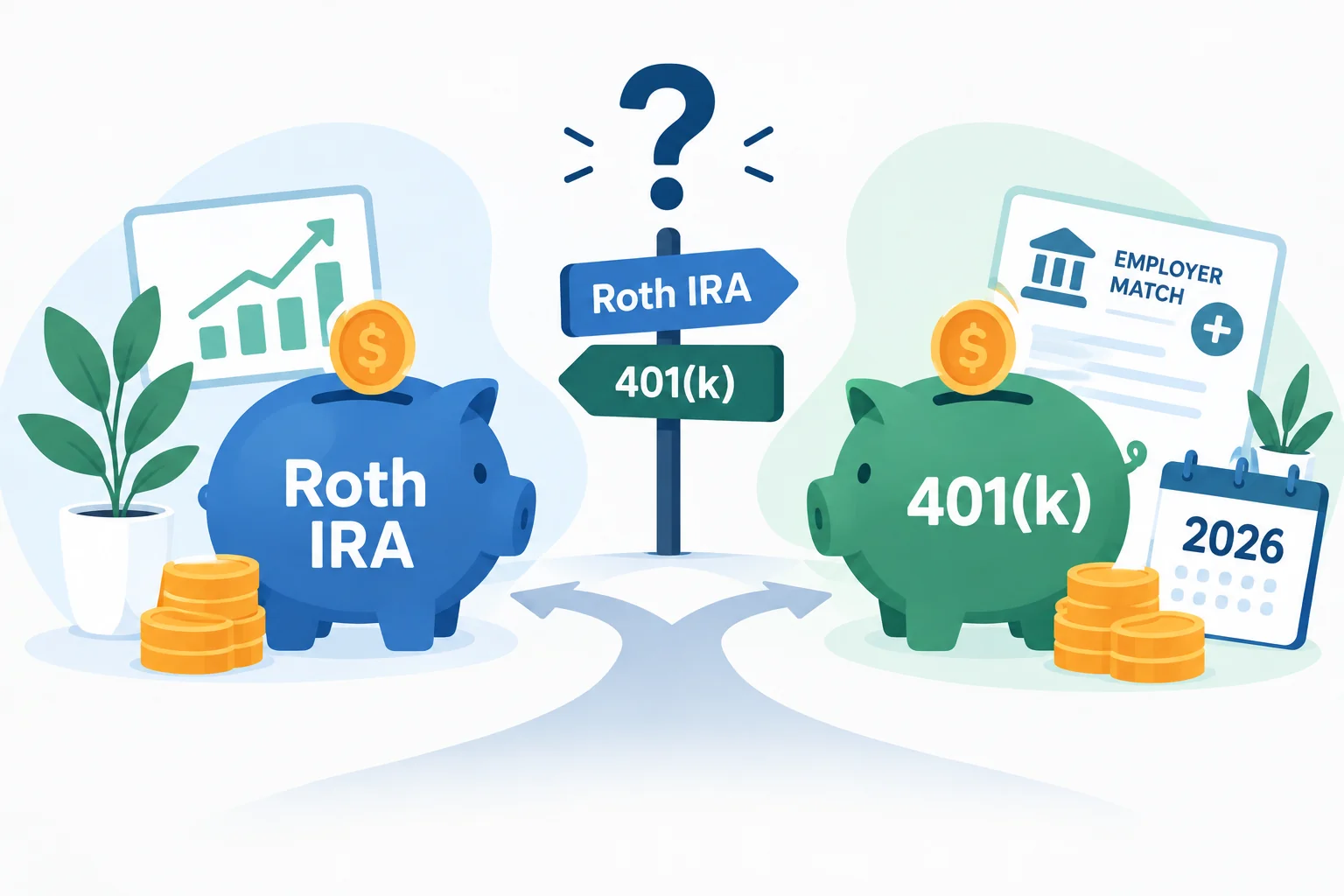
The Real Question: Pay Taxes Now or Later?
Roth IRAs and 401(k)s are not rivals so much as tools. Both shelter investment growth from annual taxes. The real difference is when you pay the IRS:
- Traditional 401(k): contributions reduce your taxable income today, and withdrawals in retirement are taxed as ordinary income.
- Roth IRA: contributions are made with after-tax dollars, and qualified withdrawals in retirement are tax-free.
Because 2026 limits rose again, most workers can now shelter more than ever. The sections below show the numbers, so you can decide how to split your savings.
👉 Compare a 401(k) and a Roth IRA with your own numbers →
2026 Contribution and Income Limits at a Glance
| 2026 Limit | 401(k) | Roth IRA |
|---|---|---|
| Annual contribution | $24,500 | $7,500 |
| Catch-up (age 50+) | $8,000 | $1,100 |
| Income limit to contribute | None | Phase-out starts at $153,000 (single) |
| Phase-out range | n/a | $153,000 – $168,000 single; $242,000 – $252,000 married joint |
| Employer match | Yes, if offered | No |
| Tax break today | Yes (traditional) | No |
Swipe sideways to see all columns. The $24,500 401(k) limit applies to your combined traditional and Roth 401(k) contributions. The $7,500 IRA limit applies across all your traditional and Roth IRAs combined. Since 2026, high earners must make their 401(k) catch-up contributions on a Roth basis.
Roth IRA vs. 401(k): Key Differences
| Feature | Traditional 401(k) | Roth IRA |
|---|---|---|
| Taxes on contributions | Pre-tax (reduces income now) | After-tax (no deduction) |
| Taxes on withdrawals | Ordinary income tax | Tax-free if qualified |
| Required withdrawals | Yes, starting in your 70s | None during your lifetime |
| Investment choices | Limited to plan menu | Nearly unlimited |
| Early access | 10% penalty plus tax before 59½ (exceptions apply) | Contributions can be withdrawn anytime; earnings are restricted |
A Roth IRA is also more flexible: you pick your own brokerage and funds, and because you can withdraw your original contributions at any time without tax or penalty, it can double as a backstop. Earnings are generally tax-free only after age 59½ and once the account has been open for at least five years.
The Tax Rate Test: Which Account Wins?
Here is the clean way to compare. Suppose you are in the 22% bracket today and invest the equivalent of $7,500 of take-home pay for 30 years at a hypothetical 7% annual return (about 7.6 times your money):
| Your Tax Rate in Retirement | Roth (after-tax $7,500) | Traditional (pre-tax $9,615) | Winner |
|---|---|---|---|
| 12% | $57,092 | $64,411 | Traditional |
| 22% | $57,092 | $57,092 | Tie |
| 24% | $57,092 | $55,628 | Roth |
Both accounts cost you the same $7,500 of spending money today. The traditional account needs a $9,615 pre-tax contribution to deliver that same take-home cost at a 22% rate.
The lesson: if your tax rate is the same, the accounts tie. Roth wins when your retirement rate is higher than today's; traditional wins when it is lower. Since nobody can predict future tax law, splitting between both is a reasonable hedge.
This simplified example ignores state taxes and assumes a constant return. Your results will vary.
Why the Employer Match Comes First
Suppose you earn $75,000 and your employer matches 50% of contributions up to 6% of pay:
- You contribute 6% = $4,500.
- Your employer adds $2,250, an immediate 50% return.
- Total going into the account each year: $6,750.
At a hypothetical 7% return, investing that $6,750 yearly for 30 years grows to about $637,600. Without the match ($4,500 a year), you would end with about $425,100. Skipping the match leaves roughly $212,500 on the table.
No Roth IRA advantage comes close to a guaranteed 50% to 100% return, which is why the match always ranks first.
👉 See how your contributions and match compound over time →
A Simple Funding Order for Most Savers
- Build a starter emergency fund so you will not need to touch retirement accounts.
- Contribute to the 401(k) up to the full employer match.
- Max out a Roth IRA ($7,500 in 2026) if your income is under the phase-out limit.
- Return to the 401(k) and increase contributions toward the $24,500 limit.
- Invest extra savings in a taxable brokerage account once tax-advantaged space is full.
Here is what that looks like for a $75,000 earner with a 50% match on the first 6%:
| Account | Your Annual Contribution | Employer Match | Notes |
|---|---|---|---|
| 401(k) up to match | $4,500 | $2,250 | Step 1 |
| Roth IRA | $7,500 | $0 | Step 2 |
| Total | $12,000 | $2,250 | 16% of gross pay |
Investing the combined $14,250 each year (your $12,000 plus the $2,250 match) for 30 years at 7% would grow to roughly $1.35 million. That is a hypothetical return, not a guarantee.
When a Roth 401(k) or Traditional 401(k) Is the Better Pick
Lean toward traditional (pre-tax) if:
- You are in a high tax bracket today (24% or above) and expect lower income in retirement.
- You need to lower your taxable income now, for example to stay under a phase-out threshold.
Lean toward Roth if:
- You are early in your career or in a low bracket (10% to 12%).
- You expect higher taxes in the future or a large pre-tax balance later.
- You want tax-free income that does not count toward required distributions.
Many employers now offer a Roth 401(k), which combines the Roth tax treatment with the higher 401(k) limit, so you can contribute far more than $7,500 on an after-tax basis.
👉 Map out your path to financial independence →
Common Mistakes to Avoid
- Leaving the employer match unclaimed. It is free compensation. Check your plan's match formula and vesting schedule.
- Ignoring Roth IRA income limits. If your income lands above $168,000 (single) or $252,000 (married filing jointly), you cannot contribute directly. A backdoor Roth is one workaround, but it has tax rules worth reviewing with a CPA.
- Picking an account and never investing the money. Contributing to a Roth IRA is not the same as owning investments. Cash in an IRA earns almost nothing.
- Cashing out a 401(k) when changing jobs. Taxes and a possible 10% penalty can erase a large share of the balance. Roll it into your new plan or an IRA instead.
- Forgetting fees. A fund charging 1% instead of 0.10% can cost tens of thousands over 30 years.
- Going all-in on one tax bucket. Having both pre-tax and Roth money gives you flexibility to manage taxes in retirement.
Frequently Asked Questions (FAQ)
Can I contribute to both a 401(k) and a Roth IRA in the same year?
Yes. They have separate limits, so you can contribute up to $24,500 to a 401(k) and up to $7,500 to a Roth IRA in 2026, provided your income is within the Roth IRA limits.
Should I max out my 401(k) or my Roth IRA first?
Neither. Start by contributing enough to your 401(k) to capture the full employer match, then fund the Roth IRA, then return to the 401(k) if you have more to save.
What if my employer does not offer a match?
Then a Roth IRA often comes first because of its lower costs and wider investment choices, especially if you are in a low or moderate tax bracket. Use the 401(k) once your IRA is funded or if you need the larger pre-tax deduction.
Is a Roth IRA better for young people?
Often, yes. Early-career workers are usually in lower tax brackets, and they have decades for tax-free growth. However, the right choice still depends on your income and expectations about future tax rates.
Can I withdraw money from a Roth IRA before retirement?
You can withdraw your original contributions at any time without tax or penalty. Earnings are generally taxed and penalized if withdrawn before age 59½ unless an exception applies, so treat the account as retirement savings first.
Do I get a tax deduction for Roth IRA contributions?
No. Roth contributions are made with after-tax money, which is why withdrawals are tax-free later. Traditional 401(k) contributions, in contrast, reduce your taxable income today.
Conclusion & Recommended Next Steps
Do not agonize over Roth versus traditional. Capture the full match, fund a Roth IRA, then top up the 401(k), and spread your savings across tax buckets to keep your options open. Run your own salary, match, and time horizon through our tools to see the difference:
401(k) vs. Roth IRA Calculator
Compare after-tax retirement balances for both account types.
Compound Interest Calculator
See how monthly contributions and your match grow over decades.
FIRE Retirement Calculator
Estimate how soon your savings rate can reach financial independence.
Paycheck Calculator
See how a 401(k) contribution changes your take-home pay.
Disclaimer: This guide is intended solely for educational and informational purposes and does not constitute personalized financial, investment, legal, or tax advice. Market returns are not guaranteed, and the 7% figure used above is a hypothetical illustration. IRS contribution limits, income thresholds, and retirement account rules change frequently. Always consult a certified financial planner (CFP) or licensed CPA before making significant financial commitments.