In Resale, Profit Is Decided When You Buy
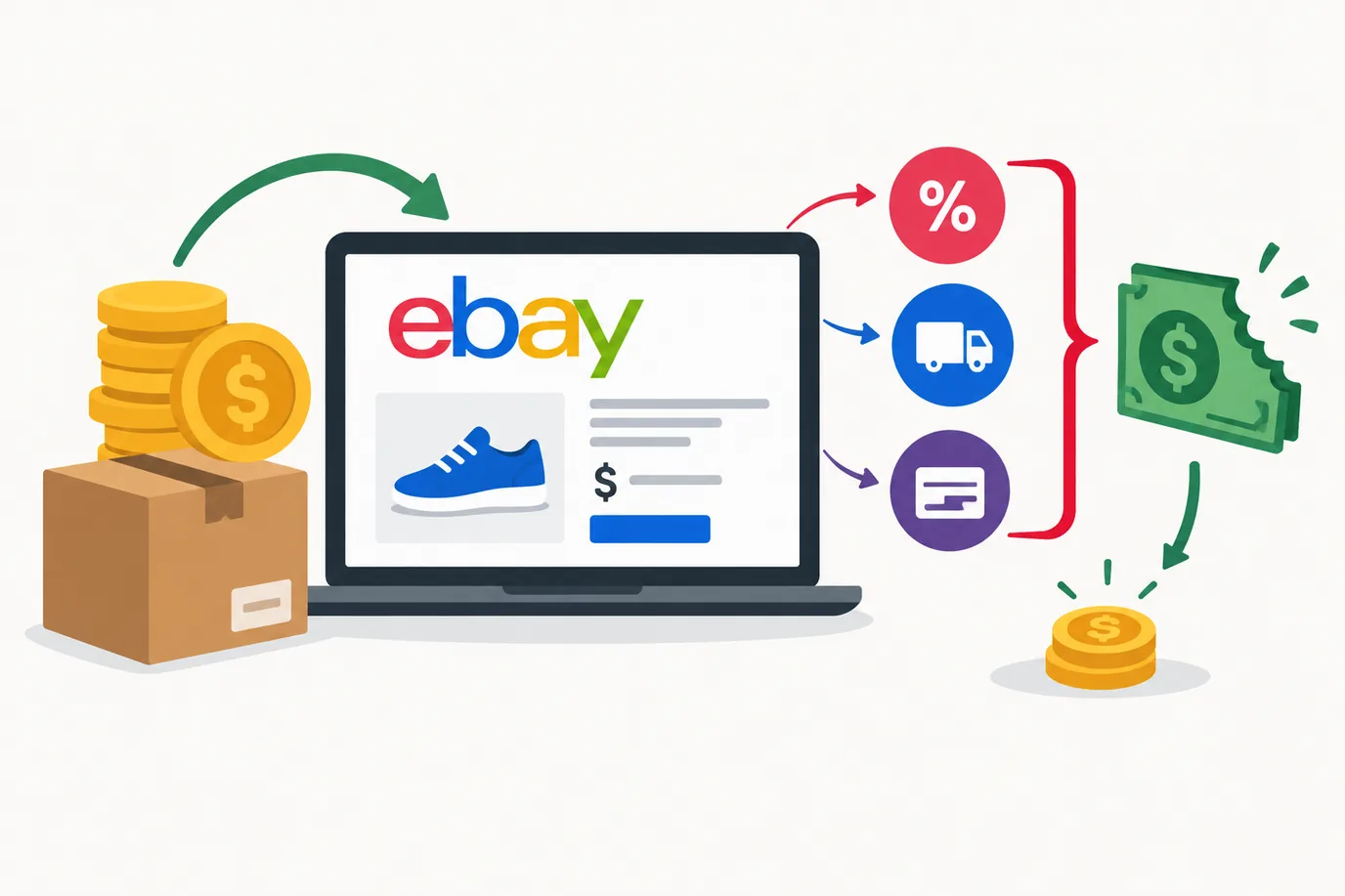
Unlike a product you make, a reseller can only influence two things: the price you pay for an item and the price you sell it at. The platform's fees and the postage sit in between and take a share. A bargain at the thrift store or garage sale is not a bargain until you have run the numbers on the sale.
Marketplace fees change, depend on the category, and often include extras, so check the current fee schedule for what you sell. The percentages and amounts below are made-up round numbers to demonstrate the method.
👉 Model your fees and profit per sale with our free eBay fee calculator →
The Example Sale
| Item | Amount |
|---|---|
| What you paid for the item | $20.00 |
| Item price | $50.00 |
| Shipping the buyer pays | $8.00 |
| Order total | $58.00 |
| Fees (example): 13% of the order total plus $0.40 | $7.94 |
| Postage you pay | $8.00 |
| Profit | $22.06 |
| Margin on the order total | 38.0% |
Swipe sideways to see all columns. The profit is $22.06, not the $30 difference between buying and selling the item. Two things are easy to miss: the fee is charged on the whole order total, including the shipping the buyer pays, and a fixed fee applies to every order. The $8 of shipping adds about $1.04 to the fees, and a buyer who pays sales tax can also raise the fee base on some platforms, so read the fee rules carefully.
What Different Selling Prices Do
Same item and same $8 shipping, different item prices:
| Item Price | Order Total | Fees | Profit | Margin |
|---|---|---|---|---|
| $40 | $48 | $6.64 | $13.36 | 27.8% |
| $50 | $58 | $7.94 | $22.06 | 38.0% |
| $60 | $68 | $9.24 | $30.76 | 45.2% |
| $70 | $78 | $10.54 | $39.46 | 50.6% |
The break-even item price is $24.65: below it you lose money. To keep a 30% margin at this cost and shipping, the item must sell for at least $41.83.
The Reseller's Key Number: The Most You Can Pay
If you know what an item sells for, you can work backwards to the highest buying price that still gives you the margin you want. For the $50 item with $8 shipping:
| Target Margin | Most You Should Pay for the Item |
|---|---|
| 20% | $30.46 |
| 30% | $24.66 |
| 40% | $18.86 |
| 50% | $13.06 |
The formula is: maximum buying price = order total − fees − postage − (target margin × order total). For a 30% margin: $58 − $7.94 − $8 − $17.40 = $24.66. Pay $30 for the item and you are at about 20%, pay $35 and the profit drops below $13. This is why experienced resellers set a maximum price before they go sourcing and walk away above it.
Where the Profit Leaks
Promoted listings and advertising
If you pay an ad rate on sales that come from promoted listings, it comes out of the same profit. A 5% ad rate on the $58 order costs $2.90, which lowers the profit from $22.06 to $19.16 (a 33% margin). Check whether the ad rate applies to the item price only or to the total, and decide if the extra sales are worth it.
Shipping you undercharge
If you charge $8 for shipping but the postage is $11, you lose $3 on every sale before fees. Weigh and measure each item, use calculated shipping, and add the cost of packaging.
Returns and "item not as described" cases
A return can mean refunding the buyer, paying return postage and getting back an item you must sell again. Photograph the condition carefully and describe flaws clearly.
Fixed fees on cheap items
A fixed per-order fee is a small number on a $50 sale and a big one on a $10 sale. For low-priced items, the fixed fee and postage can consume most of the margin.
Your time
Sourcing, photographing, listing, packing and dropping off the parcel all take time. If an item makes $5 and takes an hour, it pays $5 an hour. Our guide on setting an hourly rate shows how to value time.
A Resale Checklist Before You Buy
- Check what similar items actually sold for, not what they are listed at.
- Estimate the postage from the item's weight and size.
- Add the platform fees at their current rates, including fixed fees.
- Subtract your buying price and any cleaning or repair costs.
- Calculate the margin and compare it with your minimum.
- Set a maximum buying price and stick to it.
- Keep records of purchases and sales for taxes. Income from reselling is generally taxable, and payment platforms may report it; see our guide on self-employment tax.
To see how many sales a month you need to cover tools and storage, read our guide on break-even analysis.
Frequently Asked Questions
How do I calculate my profit on eBay?
Add the item price and the shipping the buyer pays, subtract the platform fees, the postage you pay and what you paid for the item. Divide by the order total for the margin.
Do fees apply to shipping?
On many platforms the fee is charged on the total amount the buyer pays, including shipping. Check the current fee policy for your category.
What margin should I aim for in resale?
Many resellers look for at least 30% to 40% after all costs, because of the time, risk of returns and unsold stock. Your own minimum should reflect your costs and your time.
Is free shipping a good idea?
It can help sales, but you pay the postage. If you offer it, raise the item price enough to cover it, and check the profit per order.
Do I owe tax on what I sell?
Selling items for more than you paid is generally taxable income, and rules depend on your situation. Keep records and consult a tax professional.
Conclusion & Recommended Next Steps
Resale profit is made at the checkout counter where you buy, not at the listing. Work out the full cost of selling, set a maximum buying price for your target margin and say no to everything above it. Put your own prices, shipping and fee rates in the calculator, then test a few selling prices before you source your next batch.
eBay Fee Calculator
Find your profit per sale and the price for your target margin.
Profit Margin Calculator
Check margin and markup at any price.
Break-Even Calculator
See how many sales cover your fixed costs.
Self-Employment Tax Calculator
Estimate tax on your resale income.
Disclaimer: This guide is intended solely for educational and informational purposes and does not constitute personalized financial, legal, or tax advice. Marketplace fees and policies change often, and the percentages and dollar amounts in the examples are made-up round numbers for illustration, not actual fee rates. Check the current fee policy of any marketplace and use your own costs before you buy or price inventory.