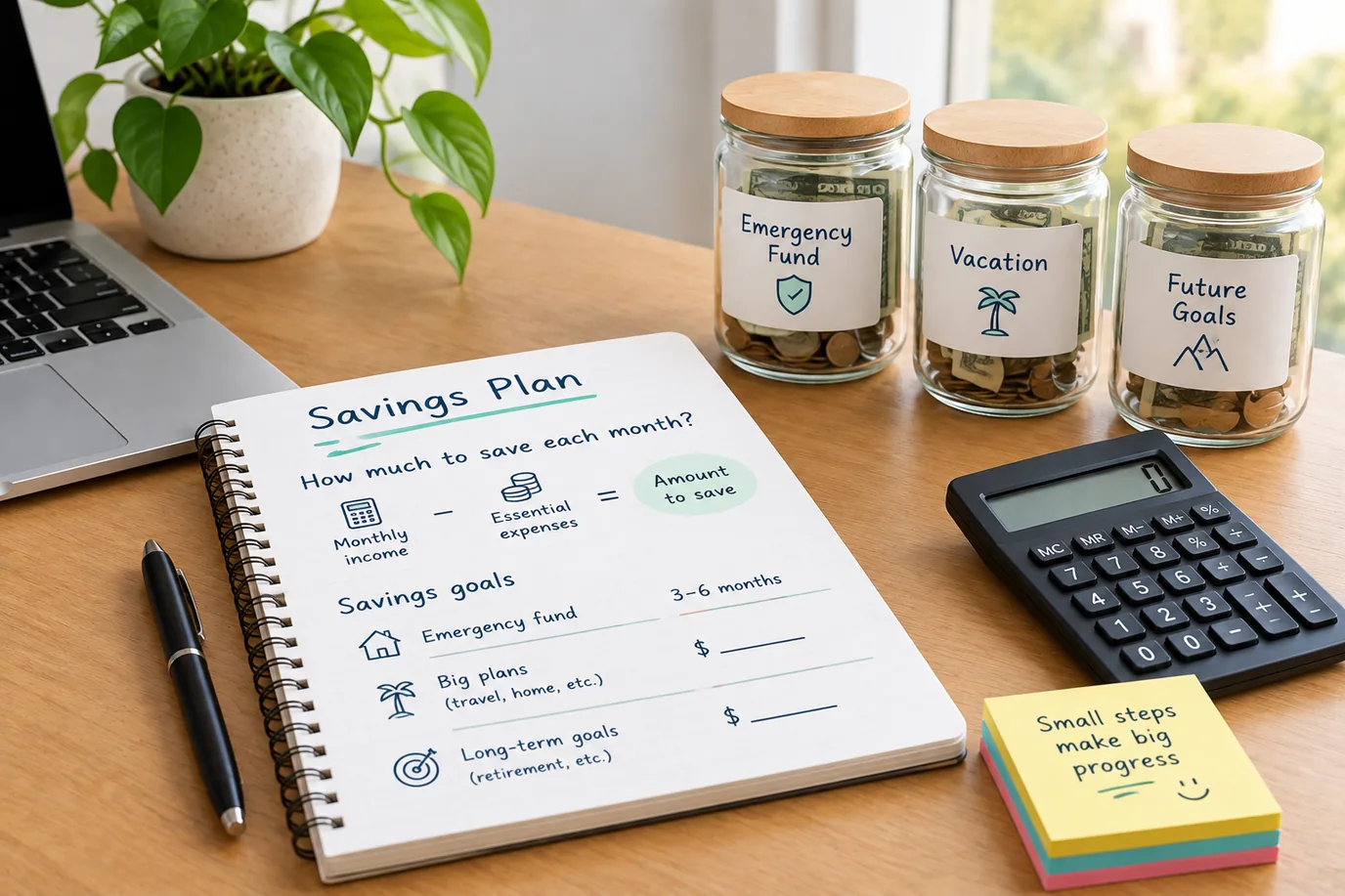
Start With a Number, Not a Feeling
"I should save more" is not a plan. A savings goal has three parts: how much you need, by when, and what you already have. With those and an expected interest rate, the monthly amount is simple arithmetic. The calculator does it for you, but it helps to see how each piece changes the answer.
The monthly amount needed is the gap between the goal and what your current balance will grow to, spread across the months in a way that accounts for interest. If you earn nothing, it is just (goal − current) ÷ months. If you earn interest, you need a little less.
👉 Find the monthly amount for your own goal with our free savings goal calculator →
Example: A $50,000 Goal With a $5,000 Head Start
All the tables below assume deposits at the end of each month and interest compounding monthly at 4.5%, which is an illustrative savings rate. Rates change over time, so use the current rate on your account.
The timeline changes the number a lot
| Time to Reach $50,000 | Monthly Savings Needed | You Deposit in Total | Interest You Earn |
|---|---|---|---|
| 24 months | $1,776.65 | $42,639.64 | $2,360.36 |
| 36 months | $1,151.11 | $41,440.02 | $3,559.98 |
| 48 months | $838.66 | $40,255.53 | $4,744.47 |
| 60 months | $651.44 | $39,086.15 | $5,913.85 |
| 84 months | $438.01 | $36,792.61 | $8,207.39 |
Swipe sideways to see all columns. (The $5,000 you already have is not counted in the deposits.) Going from 36 to 60 months cuts the monthly amount by about 43%, and a longer timeline also gives interest more time to help: it covers about 16% of the goal at 84 months but only about 7% at 36 months.
The interest rate matters, but less than the timeline
For the same $50,000 goal in 36 months starting with $5,000:
| Annual Interest Rate | Monthly Savings Needed |
|---|---|
| 0% (cash at home) | $1,250.00 |
| 2% | $1,205.58 |
| 4.5% | $1,151.11 |
| 6% | $1,118.99 |
Earning 4.5% instead of nothing saves $98.89 a month, about $3,560 across the three years. That is real money, and it is free: keeping savings in an account that pays a competitive rate instead of one that pays almost nothing costs you nothing but a few minutes. Deposits in FDIC-insured banks (or NCUA-insured credit unions) are protected up to $250,000 per depositor, per institution, per ownership category.
A head start in your balance cuts the monthly amount
The same goal and timeline, starting from different balances:
| Balance You Already Have | Monthly Savings Needed |
|---|---|
| $0 | $1,299.85 |
| $5,000 | $1,151.11 |
| $15,000 | $853.64 |
| $25,000 | $556.17 |
Each extra $10,000 you start with lowers the monthly amount by about $300. If you have a lump sum, such as a bonus or a tax refund, adding it to the account at the start can matter more than squeezing extra from each paycheck.
The First Goal for Most People: An Emergency Fund
An emergency fund covers unexpected costs, such as a job loss, a medical bill or a car repair, so you do not need to borrow on a credit card. A common guideline is to hold three to six months of essential expenses, and more if your income is uneven or you are the only earner.
If your essential expenses are $3,500 a month:
| Emergency Fund Target | Amount | Monthly Savings to Build It in 12 Months | Monthly Savings to Build It in 24 Months |
|---|---|---|---|
| 3 months of expenses | $10,500 | $857.10 | $418.93 |
| 6 months of expenses | $21,000 | $1,714.20 | $837.85 |
That can sound like a lot. A practical approach is to start with a small first goal, such as one month of expenses, then build in steps. Keep the money in a savings account that is easy to reach but separate from your daily checking account, and avoid investing it, since you need it to be there when markets are down.
Other Common Goals
| Goal | Timeline | Starting Balance | Monthly Savings Needed |
|---|---|---|---|
| $30,000 down payment on a home | 36 months | $2,000 | $720.41 |
| $10,000 for a major purchase | 12 months | $0 | $816.29 |
| $4,000 vacation | 12 months | $0 | $327.27 (at 4%) |
For the home example, see our guide on how much down payment you need to choose a target, and the rent vs. buy guide to decide if buying fits your plans.
Where to Keep Money for Each Goal
- Under about 2 years: use a savings account, a certificate of deposit or short-term Treasury bills. The value will not drop, and your money will be there when you need it.
- Five years or more: investing may be reasonable. Stocks have higher expected returns but can fall sharply in the short run. For long-term growth, see our ETF and index fund calculator.
- Retirement: use tax-advantaged accounts first. Our guide on Roth IRA vs. 401(k) explains the order.
Seven Habits That Make Saving Easier
- Pay yourself first. Move the savings out on payday, before you can spend it.
- Automate the transfer. Make it a recurring transfer so it takes no willpower.
- Name your goals. An account named "Emergency Fund" or "House" is harder to raid.
- Raise the amount when your income rises. Send part of every raise to savings.
- Cut one recurring cost and redirect it, such as an unused subscription.
- Track the progress to stay motivated: seeing the balance grow helps.
- Plan for setbacks. If you miss a month, add it to the next one rather than quitting.
If you are not sure how much room your budget has, our guide to take-home pay on a $75,000 salary and the budgeting rule in the 50/30/20 calculator can help.
Frequently Asked Questions
How do you calculate how much to save each month?
Subtract your current balance (grown by interest) from the goal and divide by the number of months, using the annuity formula to account for interest. Without interest, it is simply (goal − current) ÷ months.
How much should I have in an emergency fund?
Three to six months of essential expenses is the usual guideline. Start with one month and build up. People with variable income or dependents often aim for the higher end.
Where should I keep my savings?
For goals within two years, use an insured savings account, a CD or short-term Treasury bills, which protect your principal. For money you will not need for many years, investing may offer higher growth, with more risk.
Is it better to save a lump sum or monthly?
Both work. A lump sum starts earning interest immediately, while monthly saving builds the habit and matches your income. The calculator lets you combine them.
What if I cannot afford the monthly amount?
Lengthen the timeline, lower the goal, or start with a smaller amount and increase it. A smaller plan that you keep is better than a larger plan you abandon.
Conclusion & Recommended Next Steps
Decide the amount, the date and what you already have, and the monthly number follows. If it is too high, adjust the timeline before giving up on the goal. Try a few scenarios in the calculator, pick the one that fits your budget, and set up the automatic transfer today.
Savings Goal Calculator
Find the monthly amount to reach any target by a date.
50/30/20 Budget Calculator
Split your pay into needs, wants and savings.
Compound Interest Calculator
See how your savings grow over many years.
Down Payment Calculator
Plan how much to save for a home.
Disclaimer: This guide is intended solely for educational and informational purposes and does not constitute personalized financial, investment, legal, or tax advice. Interest rates on savings accounts change frequently, and the figures above are illustrations based on the stated assumptions. Check the current rate and insurance coverage of any account before you deposit.