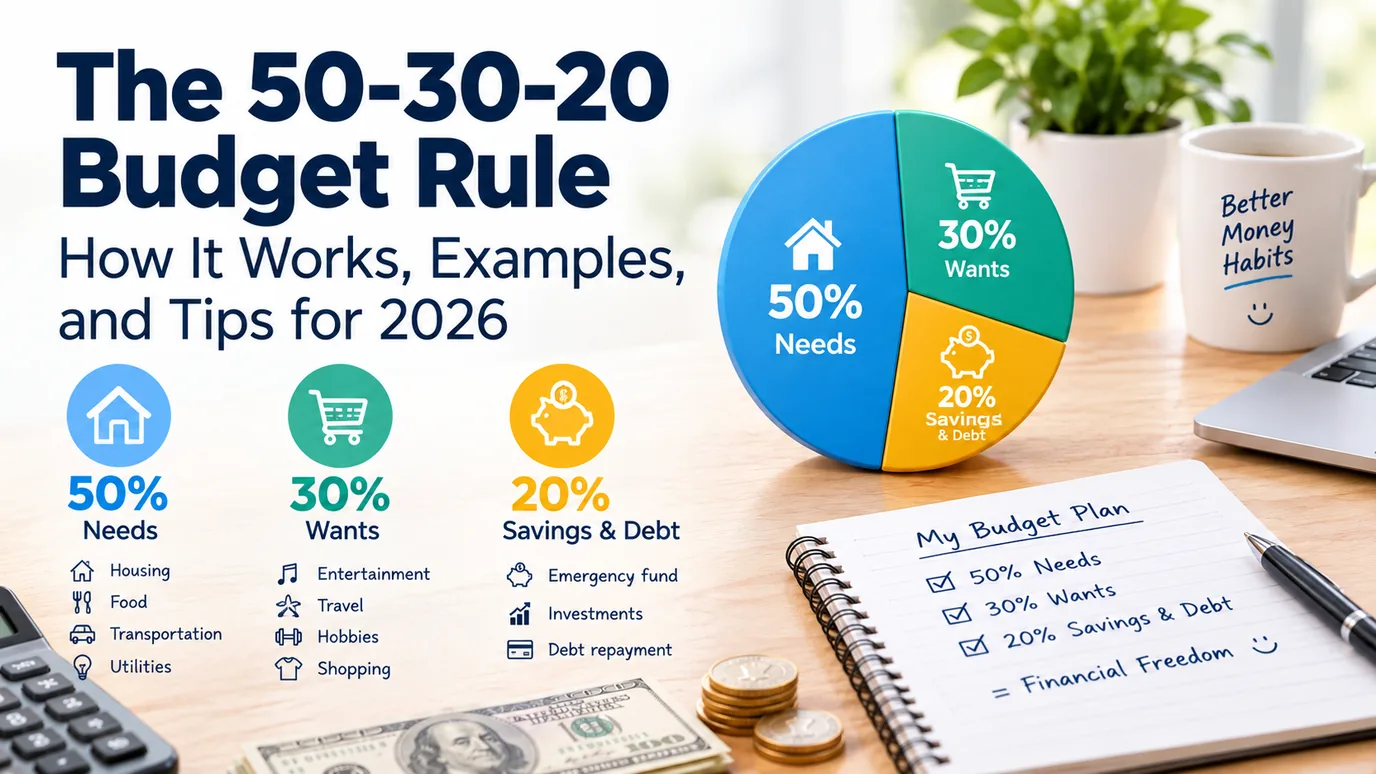
Where the 50/30/20 Rule Comes From
The rule was popularized by Elizabeth Warren and her daughter Amelia Warren Tyagi in the 2005 book All Your Worth. It became popular because it replaces dozens of categories with just three, so a budget takes a few minutes instead of a few hours.
The three buckets are based on your take-home pay, the money that reaches your bank account after taxes and payroll deductions:
- 50% needs: costs you must pay to live and work.
- 30% wants: things that improve your life but that you could reduce if you had to.
- 20% savings and debt repayment: your future: emergency fund, retirement, investing and extra debt payments.
👉 Split your own pay with our free 50/30/20 budget calculator →
What It Looks Like at Different Incomes
| Monthly Take-Home Pay | Needs (50%) | Wants (30%) | Savings and Debt (20%) | Saved per Year |
|---|---|---|---|---|
| $3,000 | $1,500 | $900 | $600 | $7,200 |
| $4,500 | $2,250 | $1,350 | $900 | $10,800 |
| $6,000 | $3,000 | $1,800 | $1,200 | $14,400 |
| $8,000 | $4,000 | $2,400 | $1,600 | $19,200 |
Swipe sideways to see all columns. Not sure what your take-home pay is? Our guide to what a $75,000 salary takes home walks through the taxes and deductions.
What Counts as a Need, a Want or Savings
Needs (50%)
- Rent or mortgage, property tax and homeowners or renters insurance
- Utilities: electricity, water, heating, basic internet and phone
- Groceries (basic food, not restaurant meals)
- Transportation to work: car payment, fuel, insurance, transit
- Health insurance and necessary medical costs
- Minimum payments on debts, such as student loans and credit cards
- Childcare you need in order to work
Wants (30%)
- Dining out, coffee shops and takeout
- Streaming, apps and other subscriptions
- Entertainment, hobbies and shopping beyond necessities
- Travel and vacations
- Upgrades, such as a more expensive phone or car than you need
Savings and Debt Repayment (20%)
- Emergency fund
- Retirement contributions (401(k), IRA)
- Investing
- Extra debt payments above the minimum
Some items fall in between: groceries are a need, but premium brands are a want; a phone is a need, but the newest model is a want. Be honest in how you sort them, since the rule only works if the buckets reflect reality.
A Realistic Example: When Needs Are Over 50%
Suppose you take home $4,500 and your real spending looks like this:
| Needs | Amount | Wants | Amount |
|---|---|---|---|
| Rent | $1,450 | Dining out | $420 |
| Utilities and phone | $220 | Subscriptions | $90 |
| Groceries | $520 | Shopping | $360 |
| Car payment and insurance | $210 | Entertainment | $250 |
| Health insurance | $100 | Travel | $300 |
| Minimum debt payments | $100 | Hobbies | $80 |
| Total needs | $2,600 | Total wants | $1,500 |
Compare it with the 50/30/20 budget of $2,250, $1,350 and $900:
| Bucket | Target | Your Spending | Difference |
|---|---|---|---|
| Needs | $2,250 (50%) | $2,600 (57.8%) | $350 over |
| Wants | $1,350 (30%) | $1,500 (33.3%) | $150 over |
| Savings | $900 (20%) | $400 (8.9%) | $500 short |
You are saving 8.9% instead of 20%, because both needs and wants are over. This is common, and it is the point where the rule becomes useful: it shows which bucket to fix first.
When 50/30/20 Does Not Fit
In high-cost cities, housing alone can exceed 50% of take-home pay. Instead of giving up, change the percentages:
| Split (Needs / Wants / Savings) | Needs | Wants | Savings | Saved per Year |
|---|---|---|---|---|
| 50 / 30 / 20 | $2,250 | $1,350 | $900 | $10,800 |
| 60 / 20 / 20 | $2,700 | $900 | $900 | $10,800 |
| 60 / 30 / 10 | $2,700 | $1,350 | $450 | $5,400 |
| 70 / 20 / 10 | $3,150 | $900 | $450 | $5,400 |
| 50 / 20 / 30 | $2,250 | $900 | $1,350 | $16,200 |
In the example above, the realistic 60/30/10 split ($2,700 for needs, $1,350 for wants, $450 for savings) means your needs now fit, you trim wants by only $150, and savings rise from $400 to $450. Then you can work toward 20% by reducing your biggest need (housing or transport) or raising income.
Low expenses or a high income point the other way: 50/20/30 sends an extra $450 a month to savings.
Five Steps to Start
- Find your monthly take-home pay. Use your last pay stub, or average three months if your income varies.
- List your last three months of spending from bank and card statements, and sort it into needs, wants and savings.
- Compare with the targets. Use the calculator to see how far each bucket is above or below.
- Fix one bucket at a time. Start with the one that is most over: often wants are the quickest to change, and needs the biggest.
- Automate the savings. Transfer the savings amount on payday so you only spend what is left.
Where the Savings Bucket Should Go
The 20% is not only for a bank account. A common order is:
- A starter emergency fund of one month of expenses, then build to three to six months. See how much to save each month in our guide to savings goals and emergency funds.
- High-interest debt, such as credit cards, since paying off a 22% balance is a guaranteed 22% return. Our guide on how credit card interest works shows the cost of waiting.
- Retirement savings, at least enough to capture any employer match. See Roth IRA vs. 401(k).
- Other goals, such as a home down payment or investing.
Limits of the Rule
- It is a guideline. Your best split depends on where you live, your income and your goals.
- It uses take-home pay. If your 401(k) contributions come out before pay, that money is already saving, so count it toward the 20%.
- It treats minimum debt payments as needs. Extra payments go in the savings bucket, which can make the 20% feel harder.
- Irregular income needs an average. Use your lowest typical months to set needs, and save more in strong months.
- Other methods exist. Zero-based budgeting or envelope systems give more detail if you prefer to track every dollar.
Frequently Asked Questions
What is the 50/30/20 rule?
It is a budgeting guideline that allocates 50% of your take-home pay to needs, 30% to wants and 20% to savings and debt repayment.
Is the 50/30/20 rule based on gross or net income?
Net income, also called take-home pay: what you receive after taxes and payroll deductions. Taxes are not a spending choice, so they are left out of the buckets.
Where do debt payments go in the 50/30/20 rule?
Minimum payments are needs, because you are obliged to make them. Anything you pay above the minimum belongs in the 20% savings and debt repayment bucket.
What if my needs are more than 50%?
Try a 60/20/20 or 60/30/10 split, then look for ways to lower the largest need or raise your income. Keeping some savings, even 5% to 10%, is better than none.
Does 50/30/20 work for a low income?
It can be harder, because necessities take a larger share. Use the split that fits and start with a small savings amount, then increase it as your income or expenses change.
Conclusion & Recommended Next Steps
The 50/30/20 rule gives you a simple starting point and a way to see where your money goes. Calculate your three buckets, compare them with what you really spend, and adapt the percentages to your situation. Enter your take-home pay and your real spending in the calculator to see exactly how far each bucket is from the target.
50/30/20 Budget Calculator
Split your pay and compare it with what you spend.
Paycheck Calculator
Find your take-home pay after taxes.
Savings Goal Calculator
See what your savings bucket can reach by a date.
Credit Card Payoff Calculator
Use your savings bucket to clear card debt faster.
Disclaimer: This guide is intended solely for educational and informational purposes and does not constitute personalized financial, investment, legal, or tax advice. The 50/30/20 rule is a general guideline and may not suit every situation, and the figures above are illustrations based on the stated assumptions. Consider consulting a qualified financial professional for advice about your own budget.