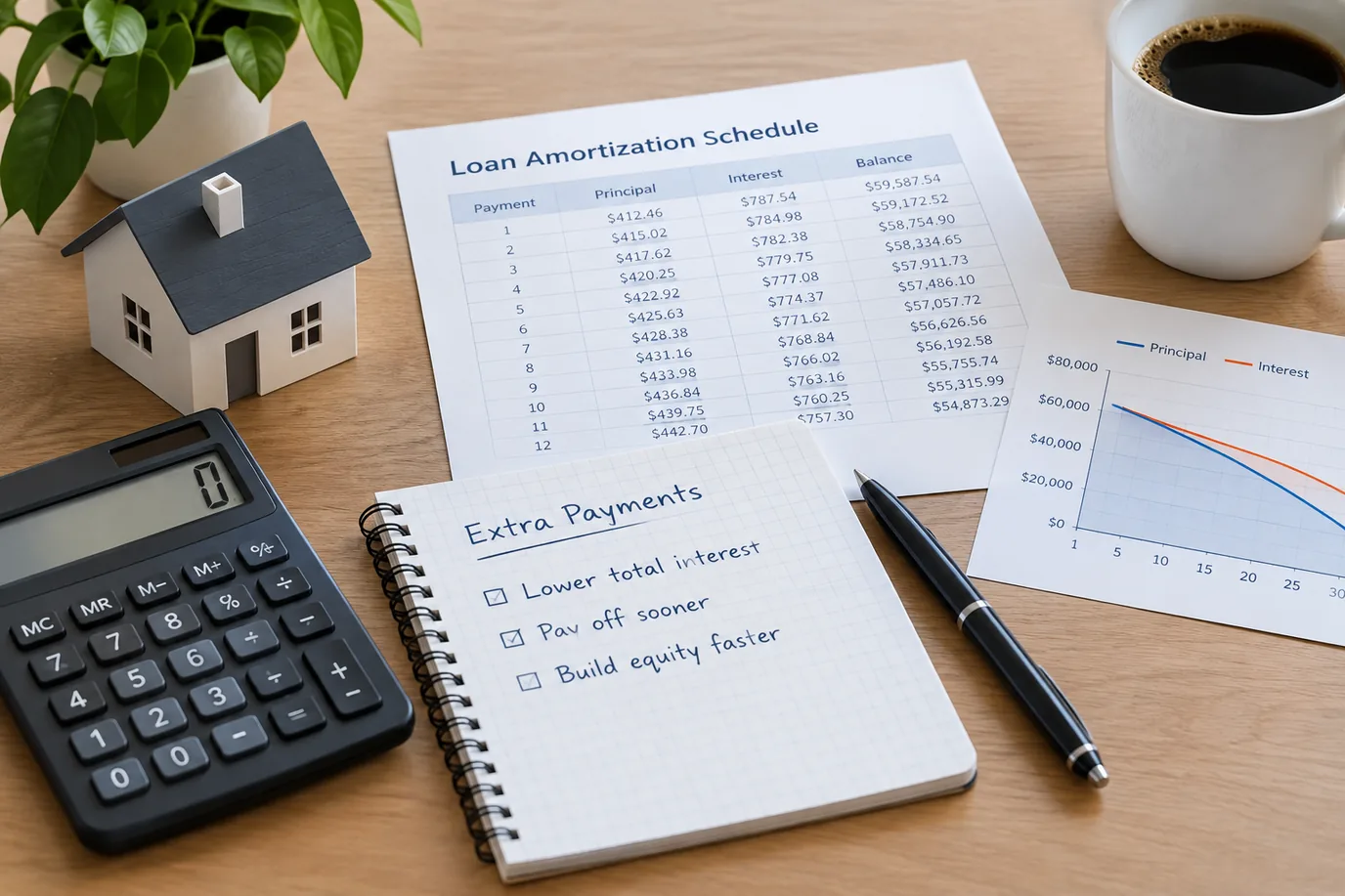
What Amortization Means
An amortizing loan is paid off in equal monthly payments that cover both interest and principal. Each month the lender charges interest on the remaining balance, and whatever is left of your payment reduces the balance. Because the balance is highest at the start, interest takes the biggest bite then. As the balance falls, the interest part shrinks and more of each payment goes to principal.
The monthly payment itself is calculated so the balance reaches exactly zero at the end of the term:
Payment = Loan × [r × (1 + r)ⁿ] ÷ [(1 + r)ⁿ − 1], where r is the monthly rate (APR ÷ 12) and n is the number of months.
👉 See your own payment and total interest with our free loan calculator →
Where Each Payment Goes
For the $20,000, 60-month loan at 7.5% with a payment of $400.76, here is how the yearly totals break down:
| Year | Interest Paid | Principal Paid | Balance at Year End |
|---|---|---|---|
| 1 | $1,383.85 | $3,425.26 | $16,574.74 |
| 2 | $1,117.93 | $3,691.17 | $12,883.56 |
| 3 | $831.38 | $3,977.73 | $8,905.84 |
| 4 | $522.58 | $4,286.53 | $4,619.31 |
| 5 | $189.80 | $4,619.31 | $0 |
Swipe sideways to see all columns. In year 1, about 29% of what you pay is interest. By year 5 it is about 4%. That is why paying extra early is powerful: every dollar of principal you remove in year 1 stops accruing interest for the whole rest of the loan.
How the Term Changes the Cost
A longer term lowers the payment but increases the total interest. For the same $20,000 at 7.5%:
| Term | Monthly Payment | Total Interest | Total Cost |
|---|---|---|---|
| 24 months | $899.99 | $1,599.80 | $21,599.80 |
| 36 months | $622.12 | $2,396.48 | $22,396.48 |
| 48 months | $483.58 | $3,211.75 | $23,211.75 |
| 60 months | $400.76 | $4,045.54 | $24,045.54 |
| 84 months | $306.77 | $5,768.30 | $25,768.30 |
Stretching the loan from 24 to 84 months cuts the payment by $593 but adds $4,168.50 of interest. Choose the shortest term whose payment you can pay comfortably. For a car-specific version of this tradeoff, see our guide on auto loan terms.
How the Interest Rate Changes the Cost
For the same $20,000 over 60 months:
| APR | Monthly Payment | Total Interest |
|---|---|---|
| 5.5% | $382.02 | $2,921.39 |
| 7.5% | $400.76 | $4,045.54 |
| 10% | $424.94 | $5,496.45 |
| 14% | $465.37 | $7,921.90 |
Going from 5.5% to 14% adds about $5,000 of interest on the same loan, though the monthly payment rises by only $83. That is why comparing offers by monthly payment alone can hide the real difference.
What Extra Payments Save
If your loan allows prepayment, any extra amount goes straight to principal. On the 60-month, $20,000 loan at 7.5%:
| Extra Each Month | New Payment | Payoff Time | Interest Saved | Time Saved |
|---|---|---|---|---|
| $0 | $400.76 | 60 months | $0 | 0 |
| $50 | $450.76 | 53 months | $549.02 | 7 months |
| $100 | $500.76 | 47 months | $964.55 | 13 months |
| $200 | $600.76 | 38 months | $1,551.63 | 22 months |
Adding $200 a month cuts the loan by almost two years and saves $1,551.63, nearly 40% of the interest. Before you do it, check that the loan has no prepayment penalty, and tell the lender to apply the extra to principal, not to the next payment.
Origination Fees: The Rate You See Is Not the Rate You Pay
Some lenders deduct an origination fee from the amount you receive but charge interest on the full loan. Here is a $20,000, 36-month loan at 7.5%:
| Origination Fee | Fee in Dollars | Cash You Receive | Total Cost | Effective Rate |
|---|---|---|---|---|
| None | $0 | $20,000 | $22,396.48 | 7.5% |
| 3% | $600 | $19,400 | $22,996.48 | about 9.6% |
| 6% | $1,200 | $18,800 | $23,596.48 | about 11.7% |
A 3% fee raises the true cost of borrowing from 7.5% to about 9.6%, because you pay interest on $20,000 but only receive $19,400. The APR the lender must disclose under the Truth in Lending Act includes certain fees, so compare APRs, not the advertised interest rates.
Choosing and Using a Loan Wisely
- Borrow only what you need. Every extra $1,000 on this loan costs about $200 more in interest over five years.
- Shop at least three lenders. Banks, credit unions and online lenders price differently, and checking rates with several lenders within a short window is generally treated as a single inquiry by credit scoring models.
- Prefer a fixed rate if you want a payment that cannot change.
- Know if the loan is secured. A loan backed by collateral, such as a car, can put the asset at risk if you cannot pay.
- Consider automatic payments. Some lenders reduce the rate for autopay, and it prevents late fees.
- Use the loan for the right purpose. If you are using it to pay off credit cards, compare the cost with the card's rate. Our guide on how credit card interest works explains what you would be replacing.
Frequently Asked Questions
How is the monthly payment on a loan calculated?
It comes from the amortization formula: the loan amount multiplied by the monthly rate and a compounding factor, divided by that factor minus one. The result is the level payment that brings the balance to zero at the end of the term.
Why do I pay so much interest at the beginning?
Interest is charged on the remaining balance, which is highest at the start. As you pay principal down, the interest portion falls and the principal portion rises, even though the total payment stays the same.
Is it better to take a shorter or longer loan term?
A shorter term costs less in total interest but has a higher payment. A longer term has a lower payment but costs more. Pick the shortest term you can afford while keeping a cushion for emergencies.
Do extra payments always shorten the loan?
Usually, if the lender applies them to principal. Some lenders apply extra money to the next scheduled payment instead, which does not reduce interest. Ask how extra payments are handled, and check for prepayment penalties.
What is the difference between interest rate and APR?
The interest rate is the cost of borrowing the principal. The APR also includes certain fees, such as an origination fee, and shows the yearly cost as a percentage, so it is the better number for comparing loans.
Conclusion & Recommended Next Steps
Amortization explains why a loan feels slow at first: the early payments mostly go to interest. Choose the shortest term you can handle, compare lenders by APR, and pay extra toward principal when you can. Enter your own amount, rate and term in the calculator to see the full schedule, and test what a small extra payment does.
Loan Calculator
See your payment, total interest and the effect of extra payments.
Personal Loan Calculator
Estimate a personal loan payment and total cost.
Auto Loan Calculator
Compare terms and rates for a vehicle purchase.
Credit Card Payoff Calculator
Compare paying down a card with taking a loan.
Disclaimer: This guide is intended solely for educational and informational purposes and does not constitute personalized financial, investment, legal, or tax advice. Loan rates, fees and terms depend on your credit and the lender and change over time, and the figures above are illustrations based on the stated assumptions. Compare written offers from several lenders before you borrow.